Identify Inside
The one surface sellers rarely photograph
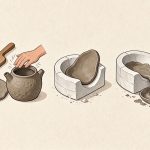
Photographs of Yixing pots are taken from three angles: front, three-quarter, and the base with the seal. The interior is almost never shown, which is precisely why it is the most useful thing to examine. Inside a pot, the making process leaves physical records that no listing can imitate.
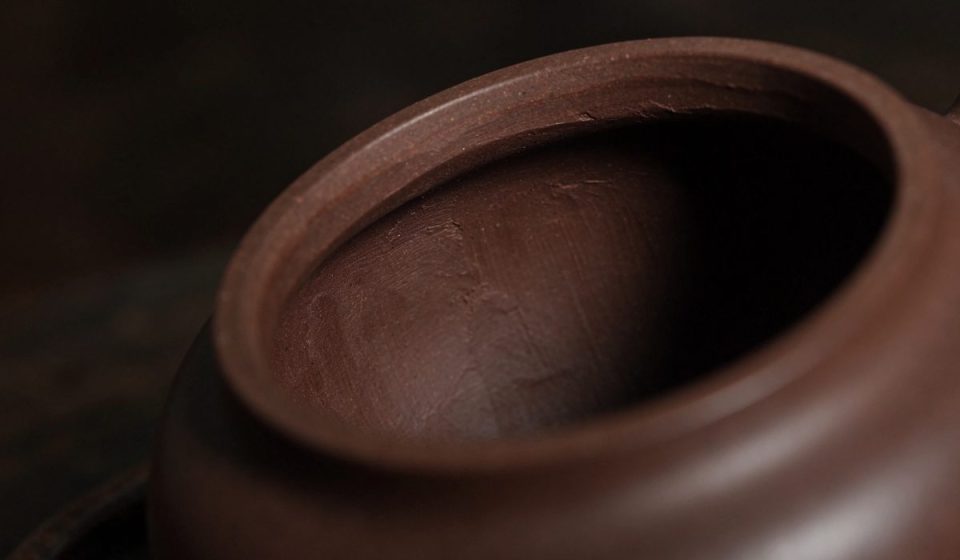
What handmade interiors show
- Wheel lines. Faint concentric rings on the floor of the pot, from the body being turned on a wheel head. They should be irregular in spacing, not a machined grid.
- Join lines. Where slabs were joined, a faint seam or a slightly different texture. Often smoothed but not erased.
- Spout penetration. A small ridge or thickening on the inner wall where the spout was pushed through and worked flat. It is usually slightly asymmetric.
- Uneven floor. The bottom is rarely perfectly flat; there is a gentle rise toward the centre or a slight hollow.
- Wall variation. Run a finger around the inside at mid-height; thickness varies subtly.
What cast interiors show
A slip-cast body is smooth, even and featureless. The interior may be a slightly different colour, with a faint sheen. There is no spout ridge because the spout is moulded separately and glued or fettled on; instead you may see a circular plug mark opposite the spout. The floor is perfectly flat and the wall thickness is constant to the millimetre.
Press-moulded bodies sit between the two: some tool marks, but a mechanical regularity and often a visible seam line where the mould halves met, running down one side or around the base.
Why smooth interiors are not automatically bad
A very well finished handmade pot can have a fairly smooth interior, especially in zhuni where the clay is fine. Smoothness alone proves nothing; what matters is the combination. A smooth interior with visible spout-working, a slightly uneven floor and a soft sheen is fine work. A smooth interior with a plug mark, a razor-flat floor and a glassy surface is casting.
How to look
Use a phone torch, hold the pot upside down, and look along the wall rather than straight down. Raking light shows texture far better than direct light. Then turn the pot slowly and watch for the highlight moving across the inner wall — irregularities reveal themselves as the highlight breaks.
If you are buying remotely, ask for exactly this: a short video, torch inside, pot rotating. A seller who will send it is a seller with nothing to hide.
What the interior cannot tell you
It cannot tell you the clay family, the firing temperature, or who made the pot. It tells you the method — and method is the single biggest determinant of price after the clay itself. That is enough to make it worth thirty seconds of your attention on every pot you consider.