Identify Forming
Three ways a body gets made
The first question to settle about any pot is how the body was formed, because it determines the price, the uniformity, and what you should expect inside. There are three methods in common use, and all three are legitimate — the problem is only when the label misdescribes the method.
Fully handmade
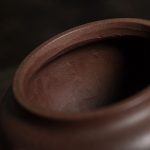
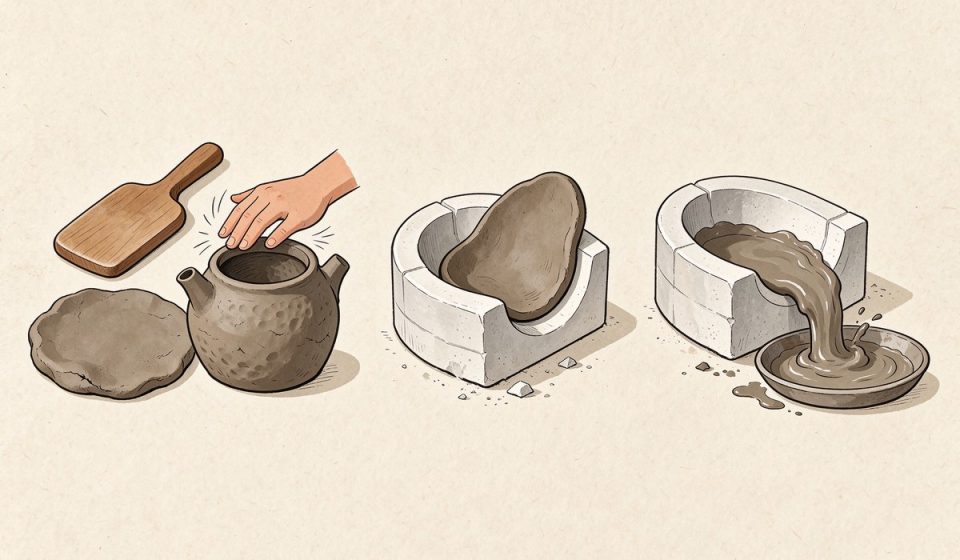
The body is built from slabs and coils on a wheel head, shaped with paddles and ribs, then joined, smoothed and fitted entirely by hand. Every pot differs slightly. The interior shows working: uneven floor, faint concentric lines, a seam, a slightly variable wall.
Cost comes from time and skill, and from a high failure rate — thin walls plus high firing means losses. This is what “quan shou gong” means, and it should be priced accordingly.
Half handmade
The body is formed in a mould — often a plaster or resin master — and then finished, fitted and detailed by hand: rim trimmed, foot turned, spout and handle set, surface worked. The result is more uniform than fully handmade and considerably cheaper, while still showing hand-finishing in the joints and the rim.
This is the honest middle of the market and where many good everyday pots come from. Interior in a half-handmade pot may be smoother than a fully hand-built one, but it still shows tool marks, and the wall will have some variation.
Cast, pressed or machine-made
Slip casting pours a liquid body into a mould; press-moulding forces clay into a two-part die. Both give a body with an even wall, a smooth interior and near-perfect repetition. Both are cheap, and both are widely used for decorative and souvenir pots.
The signature is uniformity: identical pots by the dozen, glassy interiors, mechanically perfect circularity, and a base or rim that shows a mould seam or a plug where a separate base was inserted.
How to tell them apart in thirty seconds
- Interior: tool marks and unevenness → handmade or half; smooth and glassy → cast.
- Wall at the rim: slightly variable → hand-finished; exactly constant all round → moulded.
- Foot: hand-trimmed with a slightly irregular inner edge → handmade; crisp but machine-even → press-moulded.
- Spout joint: a clean, slightly thickened junction with tool marks → hand-set; a raised ring or shadow gap → inserted into a cast body.
What to pay for which
Cast pots can be fine as decoration and acceptable as occasional brewing vessels if the material is sound; pay cast prices. Half handmade is the value tier for daily use. Fully handmade is worth its premium when the walls are thin, the fit is precise and the shape is difficult — not merely because a listing says so.
The disclosure test
Ask: “Is this fully handmade, half handmade, or moulded?” A seller with a real workshop answers instantly and without offence. A seller who answers “it’s handmade, all Yixing pots are handmade” is telling you the answer already.