Identify Seal
A pressed mark is a physical event
Seals are usually discussed as names. They are better discussed as impressions: a carved stamp pressed into leather-hard clay leaves a record of pressure, carving and settling that no amount of photographic copying reproduces exactly.
The practical value of this is that you can evaluate a seal without reading Chinese. What you are looking at is clay behaviour.
Depth
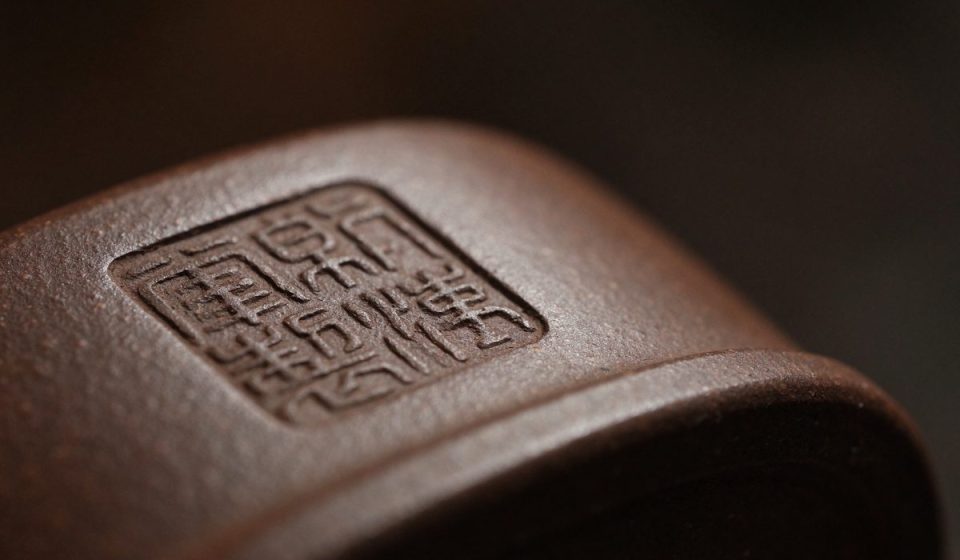
A hand-pressed seal sinks into the base to a depth that varies slightly across the square — deeper at the corner where the thumb pressed hardest, shallower at the opposite corner. Around the edge, clay is displaced upward into a low lip, and the lip is uneven.
A moulded or printed mark sits at constant depth, often very shallow, with a flat, machined look and no displaced clay at all. If the “seal” appears to be painted on, it is: some cheap pots have a transfer print that darkens in the kiln.
Font and stroke quality
Traditional seals are carved, usually in seal script. Carved strokes have visible variation: a slightly ragged edge, a stroke that gets thinner at the end, a small chip from the chisel. Identical, ruler-straight strokes with perfectly uniform width suggest a modern stamp made by etching or laser, not carving.
You do not need to identify the characters. Ask: could this have been cut by hand, or does it look manufactured? Nine times in ten, the answer is visible at a glance.
Placement
Conventions vary, but a few patterns hold. The base seal sits inside the foot ring, roughly centred, its edges parallel to the pot’s geometry. The lid seal is usually the same characters, smaller, in the centre of the lid’s inner surface. Body or handle seals are smaller still and often positioned asymmetrically.
Sloppy placement — a seal clipped by the foot ring, rotated a few degrees off the geometry, or crammed off-centre — is common in fast production. Careful placement indicates care elsewhere in the making.
Relief versus incised
Most base seals are incised (recessed) so the impression stands proud; some are relief stamps that press a recessed impression. Either is normal. What is not normal is a mixture on the same pot without reason, or a base seal in one style and a lid seal in a completely different one.
How copies are made now
Three methods are common: a physical stamp copied from a photograph by a seal-carving shop; a polymer stamp produced from a digital file; and a direct print applied to the clay or to the fired surface. The first can produce a convincing impression; the second usually cannot; the third is obvious under raking light.
This is why a seal can support a story but never establish one. The stamp is a commodity; the pot is not.
A thirty-second routine
- Look at the base seal under raking light: depth variation, displaced clay lip, stroke quality.
- Compare the lid seal to the base: same characters, proportionally smaller, different impression depth.
- Check placement: parallel to the geometry, centred, unclipped.
- Then stop and judge the pot’s pour, lid and interior. Those decide the price; the seal only decorates it.