Reading Clay Texture: Sand Grain, Density, Speckles
Surface is evidence, not decoration
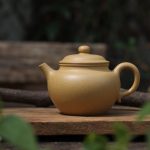
The fired skin of a zisha pot is one of the few things a buyer can examine directly, without trusting a label. Grain, density, specks and colour variation all come from the clay and the kiln — and all are difficult to fake convincingly at scale.
Grain: what “sand” means in purple sand
Zisha is not a smooth paste. It is a body with mineral particles — quartz, mica, iron-bearing grains — of different sizes, held in a finer matrix. When the pot is fired, some grains stand slightly proud, some melt into the surface, some leave a dark speck. That is what gives zisha its characteristic faintly sandy look and its grip under the thumb.
Fine clay pots exist, especially in zhuni, where the grain is small enough to read as a smooth sheen. Coarse, sand-tempered bodies (tiaosha) deliberately add grit, which makes the body more open and gives a rougher, more rustic surface.
Three readings of texture
- Fineness. A very smooth, glassy surface with no grain at all is usually a sign of a lean industrial body, a slip, or a cast body finished mechanically. Genuine clay, however fine, still shows a slight tooth under a fingernail.
- Uniformity. Natural clay is slightly inconsistent: a pot may be a shade darker on one side because of kiln position. Perfectly even colour across every surface, inside and out, is a manufacturing tell.
- Sheen. Fired, unglazed, unused zisha is matte — it scatters light. Gloss comes from use (patina), from a slip, or from polishing at the workshop. Buy a new pot that looks shiny and you are buying a surface treatment, not a material.
Specks: read them, do not fear them
Dark specks are usually iron-rich grains that have melted or partially melted. Pale specks can be quartz or mica. A few are normal and desirable — they show that the body is clay, not a refined paste. Lines of identical specks repeating at regular intervals are not natural; they are a printed or cast pattern.
The dangerous cases are different: bright metallic flecks, a glittery sparkle, or coloured dots that sit on top of the surface. Those suggest a decorative treatment rather than clay, and they are the kind of thing to avoid in any pot you plan to brew in.
Density and weight
Pick the pot up. For a given capacity, well-fired zisha is heavy and slightly cold to the touch. A pot that feels light for its volume is either thin-walled (fine, if the potter meant it), under-fired, or made from a leaner body. Compare two pots of the same nominal size: the difference in weight is often the fastest quality signal you will get.
Interior texture matters more
Turn the pot over and look inside with a torch. The inner surface should look rougher than the outside and should show working: faint concentric lines, a slight unevenness, a small ridge where the spout pierces the wall. A smooth, glassy, uniformly coloured interior with no tool marks and no variation is the signature of casting — and casting is not a crime, but it should not be sold as handmade.
How to practise this
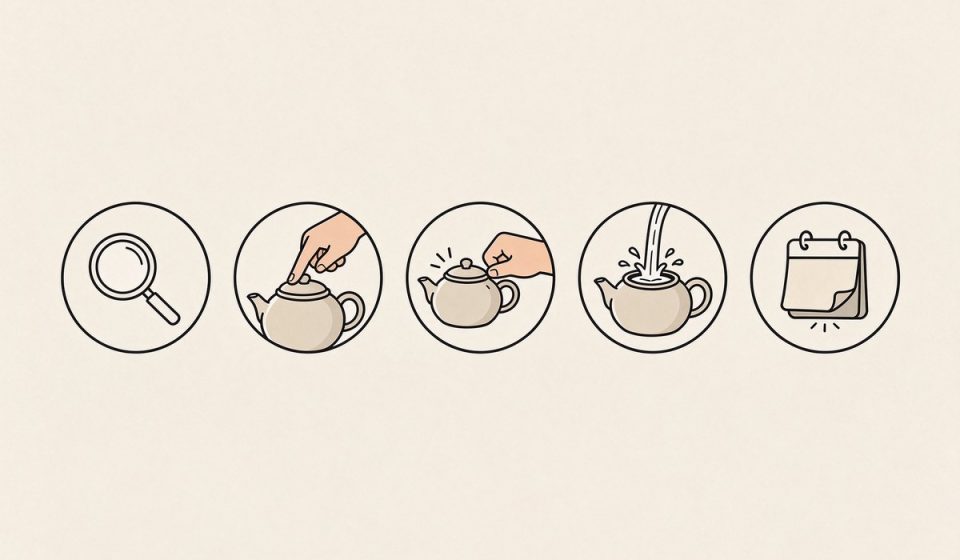
Handle ten pots you have no intention of buying and note three things on each: weight, surface tooth, and interior texture. Within an hour your hands will have learned more than a week of reading listings — and the vocabulary on this site will start to attach to sensations instead of claims.