What “Zhuni” Really Means, and Why the Word Is Overused
A word doing too much work
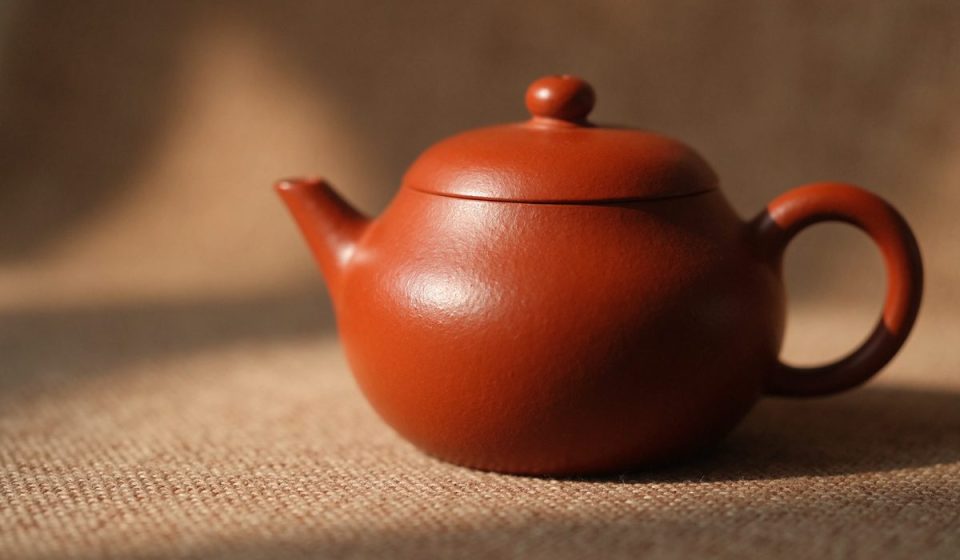
Zhuni (朱泥, “cinnabar mud”) is the most overused word in the zisha trade. In its strict sense it refers to a specific family of high-iron, high-shrinkage red clay that fires to a dense, bright red-orange body. In commercial use it has come to mean “red pot”, which covers everything from a genuine zhuni Xishi to a cheap cast body with a red slip.
Understanding why the word spread is the quickest way to stop being fooled by it.
What genuine zhuni is like
- Shrinkage: high — often quoted at 15–25%, which is why zhuni pots are small and simple, and why complex shapes in zhuni are rare and costly.
- Sound: a high, short, almost metallic ring when tapped, distinctly higher than zijin.
- Surface: fine-grained and dense, with a slight sheen that develops quickly with use; less visible sand grain than zijin.
- Colour: red-orange to deep crimson, with subtle variation across the body rather than a flat, uniform tone.
- Weight: heavy for its size.
Why the copies are so common
Red sells, and real zhuni is difficult: high shrinkage means cracks, warping and a brutal scrap rate, so the genuine article costs several times what a similar-sized zijin pot does. A workshop that wants red output without that cost has three easy routes: a red-coloured slip over an ordinary body, a cast body with a red-tinted surface, or a blended clay with red iron oxide added to imitate the colour.
Each route leaves traces. Slips show as a sharp colour difference between outside and inside, or a slightly plastic sheen. Cast bodies show smooth interiors and mechanically perfect circularity. Oxide-tinted blends often look too even and too saturated, and lack the subtle depth of genuine fired zhuni.
Four checks that carry weight
Sound. Tap the lid lightly on the body. A genuine zhuni pot gives a clear, high, short note. A slip over a coarser body gives a duller, longer sound.
Inside colour. Look into the pot with a torch. If the interior is visibly different in colour and texture from the exterior, you are looking at a coated body.
Break the surface myth. Genuine zhuni is not glossy. A high-gloss, mirror-like red surface is almost always a coating; real zhuni has a soft sheen that deepens with use.
Look for variation. Fired clay is never perfectly even. A pot whose red is identical on every surface, including inside the foot ring, has been coloured, not fired.
What it costs to be real
A genuinely handmade zhuni pot in the 100–150 ml range is a serious object: hours of work, a high failure rate, and a small number of workshops able to do it well. Prices reflect that. If a listing offers “pure zhuni, fully handmade, master level” at the price of two ordinary pots, something in the sentence is false, and it is rarely the price.
A reasonable position
You do not need zhuni to enjoy zisha. A good zijin pot brews as well and lasts as long. Buy zhuni when you specifically want the dense body, the high ring and the way it handles small, high-ratio brews — and buy it from someone who will show you the interior, the base and the pour, and who will accept a return.