Duanni and Its Many Variants
The pale clay and its problems
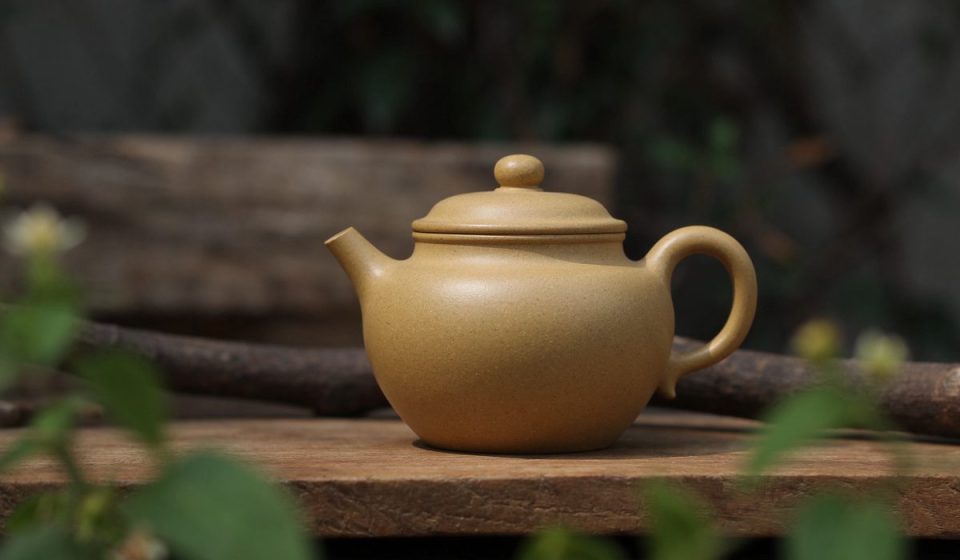
Duanni (段泥) is the light-coloured branch of the zisha family: lower iron, fired to yellow, cream, tan or pale greenish tones, often with dark specks where iron-bearing grains have melted. It is the most visibly different of the common clays, and it has two persistent problems: it is easy to fake, and it stains.
Why it looks the way it does
Iron oxide is what gives zisha its red and purple range. Reduce the iron and raise the proportion of other minerals and the fired body goes pale — the difference between a brown pot and a cream pot is largely a difference in iron and in the amount of air the kiln allowed during firing. Duanni also tends to fire slightly more open than zijin, which is why the surface often looks sandier.
Within duan the trade distinguishes several sub-types by colour and by the seam they came from: the classic yellow-tan, a greenish-grey variant, and paler, almost bone-white bodies sold under various names. Most of the naming is local and inconsistent, and a good deal of it is invented for listings.
Problem one: staining
Light-coloured, open-bodied clay shows tea. A duanni pot used daily with dark tea will develop an uneven stain along the rim, in the valleys of any carving, and around the spout. Some drinkers find this attractive — it is patina, after all — but on a pale body it reads as dirt more readily than on a dark one.
Practical consequence: duan pots are better suited to lighter teas (green tea, light oolong, white tea) both for taste and for appearance. If you brew ripe pu-erh in a cream-coloured pot, expect it to look like it.
Problem two: imitation
Because the colour is unusual, duan attracts coatings. The usual trick is a pale slip over a cheap body, sometimes with dark specks painted or sprayed on to imitate iron grains. The tells are the same as everywhere: a colour difference between outside and inside, specks in suspiciously regular patterns, and a surface that looks painted rather than fired.
A genuine duan body has colour variation across faces, a matte surface with visible tooth, and specks of different sizes and shapes distributed unevenly. The colour at the base ring and inside the lid seat should be continuous with the exterior, not a masked edge.
Brewing behaviour
Duan is usually a little more open than zijin, which means slightly more absorption and slightly less heat retention. In a thin-walled pot this makes it a decent choice for teas you do not want to overheat — light oolong, some green teas, white tea. In a thick-walled duan pot the openness plus the mass can mute a delicate tea into dullness.
If you want one pot for both appearance and function, duan is best bought in a small, thin-walled form with a wide opening, used for one light tea, and rinsed rather than scrubbed.
What to check when buying
- Colour continuity inside and out — no masked edges, no white interior in a cream pot.
- Specks of varied size, irregularly distributed; not a repeating printed pattern.
- Surface matte and slightly granular; suspicions raised by high gloss.
- Weight plausible for the wall thickness — duan can be surprisingly light.
- Stain history if second-hand: an evenly stained genuine duan pot is normal; a pot stained only in the carved lines and nowhere else is probably a coated body whose coating is wearing through.
A fair summary
Duanni is a real and pleasant material with a distinct look, best used for light teas in modest sizes. It is also the branch of the family where imitation is easiest, so buy the pot’s physical evidence first and the colour last.