Why the Same Clay Fires to Different Colours
Colour is made in the kiln, not in the bag
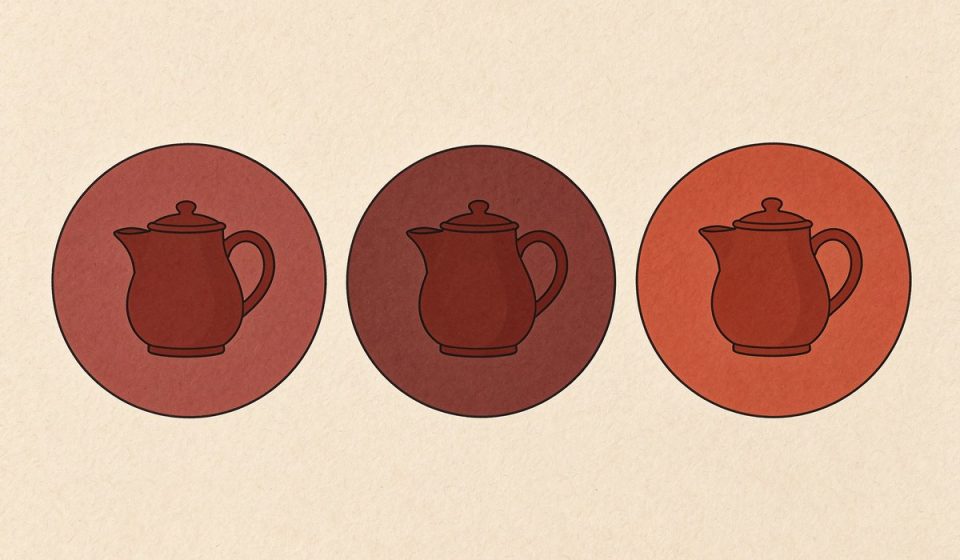
Two pots made from the same clay, in the same workshop, can come out visibly different in colour — one brick red, one brown-violet, one almost grey. This is not a trick or a defect. It is the chemistry of iron in a kiln, and understanding it explains a great deal about how zisha is priced, judged and faked.
Iron, oxygen and temperature
The colouring agent in zisha is iron oxide. What colour it produces depends on three variables:
- Temperature. Below about 1,050 °C the body stays dull and earthy; around 1,100–1,200 °C the iron reacts and the body develops its characteristic depth; too hot and the surface begins to close and flatten.
- Atmosphere. In an oxidising kiln (plenty of air), iron goes to the red-brown ferric form. In a reducing kiln (air deliberately restricted), it moves toward grey, blue-grey and darker tones. Ancient wood-fired “dragon kilns” produced strong reduction; modern electric and gas kilns are usually oxidising but can be run either way.
- Cooling. Slow cooling lets the surface re-oxidise slightly; fast cooling can freeze a different state. Small pots cool faster than large ones, which is one reason size affects colour.
Why the same clay looks different
Position in the kiln matters. A pot near the burner sees more heat and more air than one at the top of the stack; a pot behind a saggar sees less oxygen. In a workshop firing fifty pots at once, there will be a colour spread across the batch, and a potter will sort them by darkness before grading. This is why a “pair” of identical pots made together may not match perfectly, and why a genuinely hand-fired pot often has a slightly uneven tone that a photograph cannot capture.
Thickness and surface
Thicker walls hold heat longer, so their surfaces stay hot further into cooling and often finish a shade darker. Where the wall is turned thin at the rim, the colour can be lighter. On carved or ribbed pots, the crests are exposed to more air and heat than the valleys, and the contrast between them is a natural artefact of firing — often imitated, badly, with a wash applied after firing to darken the recesses.
What this means when you buy
- Perfect uniformity is suspicious. A pot that is exactly the same colour on every face, inside the foot ring and under the lid may have been coloured rather than fired.
- A slight colour shift is normal. A darker band near the base, a lighter lid, a faint tonal difference between body and spout are acceptable on handmade pots.
- Judge the whole surface. Fired clay shows transitions; coatings show edges — a line where the colour stops.
- Do not buy by colour name. “Purple” and “red” describe a family and a fired outcome, not a specification.
The faking shortcut
Because buyers judge by colour, cheap production colours the surface. Three common techniques: a slip of fine coloured clay over a coarse body; a pigment wash applied before firing that burns to a uniform tone; and after firing, a wax or oil polish that deepens the apparent colour and hides the grain.
The tests are physical. Rub a damp white cloth on an inconspicuous area: real fired colour gives nothing; wax or pigment gives a smear. Look at the base ring interior, where masking is awkward: real pots are coloured there by the same firing; coated ones show bare clay or a second colour.
A useful habit
When you handle a pot, look at three zones before deciding anything: the inside of the lid seat, the underside of the foot, and the area behind the handle. These are the places where colouring is hardest to apply evenly. If all three agree with the exterior and show the same grain, the colour came from the kiln. If they disagree, it came from a brush.