Clay Purity: What Inclusions Actually Tell You
What “pure” can mean in a clay body
In the zisha trade, “pure clay” (chun ni) usually means the ore was processed with minimal additives: weathered, ground, wetted, aged, and formed without mixing in other clays to change its colour or working properties. It does not mean the body is chemically pure — real zisha is a mixture of minerals and would be useless if it were not — and it does not mean the pot is free of temper.
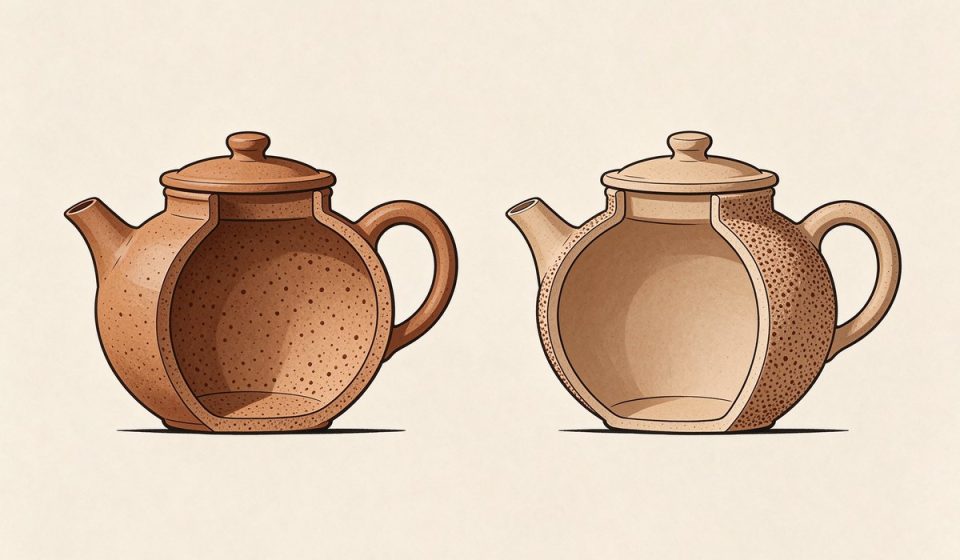
Temper is normal. Sand-tempered bodies (tiaosha) add coarse quartz or fired clay grit to improve strength, reduce shrinkage and open the structure. Blended bodies (pin ni) combine two or more clays to get a colour or working character neither could give alone. Both are legitimate traditions. The problem is when a blend is described as a single famous seam and priced accordingly.
Inclusions: the useful kind
A good zisha body shows inclusions. Fine mica gives a faint sparkle; quartz grains give tooth; iron-bearing grains melt into dark specks. On the surface these read as character, and inside the body they improve firing behaviour by reducing shrinkage stress.
What you do not want are inclusions that look applied: bright metallic flecks, uniform coloured dots, glitter that sits on the surface rather than in it. Those suggest decoration or a slip, not a natural body.
Sand content and how it feels
A strongly tempered body feels gritty under the thumb and looks coarse. This is not low quality — some of the most durable, best-brewing pots are deliberately sandy, because the grit reduces shrinkage and cracking and gives an open wall that behaves well with heat. A very fine, glassy body with no grain at all is more likely to be industrial than artisanal.
The practical test: drag a fingernail lightly across an inconspicuous area. Real clay gives a faint, dry resistance and a soft sound. A sealed or coated surface slides.
Purity and price
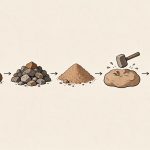
Processing matters more than the label. Ore has to be weathered (exposed to sun and rain), crushed, mixed with water, kneaded, and aged to develop plasticity. Cheap production skips the long steps: mechanical grinding, minimal ageing, additives to make a difficult body workable, and slip casting instead of forming.
None of this is visible directly, but its consequences are: a hurriedly processed body tends to feel heavier, denser and more uniform, with less grain and less colour variation, and it fires with more scrap and fewer fine pots.
Two things that are not purity tests
- Colour. A very even, saturated colour suggests a coating, not purity.
- A famous mine name. “Old mine clay” is a phrase, not an assay.
How to judge a body in a shop
Look at four surfaces — outside, inside, under the lid, under the foot — and ask whether they could plausibly be the same material formed and fired. Weight it. Tap it. Drag a nail across it. Then ask the seller what the body is, what was added to it, and how it was processed. A specific answer, including “we temper it with quartz grit” or “this is a blend of two seams”, is a better sign than a famous name with no detail.