The Main Zisha Clays: Zijin, Zhuni, Duan and Qingni
One family, several branches
“Zisha” is a family name, not a single material. The ores dug around Dingshu differ in iron content, in the proportion of quartz and mica, in how much kaolin they carry, and in how they behave when fired. Four branch names do most of the work in the trade: zijin, zhuni, duanni and qingni. Understanding what each one is — and is not — saves you from a great deal of sales talk.
Zijin: the purple reference clay
Zijin, “purple-gold”, is the broad category most pots are made from. It is iron-rich, fires to brown-red through deep purple-brown, and is relatively forgiving: good plasticity when wet, moderate shrinkage, and enough strength in the fired body to make thin walls practical. Most of the classic shapes in the canon were first worked in this kind of clay, and most copies still are.
Within zijin the trade separates sub-variants by seam and by depth: the darker, denser ores; the sandier, more open ones; and the lighter, warmer ones sometimes sold under separate names. The differences matter to potters choosing a body for a particular shape, and matter less to buyers than the quality of the firing.
Zhuni: the red clay that shrinks
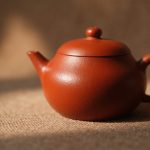
Zhuni fires red-orange to crimson and shrinks dramatically — commonly quoted at 15–25% linear shrinkage, against roughly 8–12% for ordinary zijin. That shrinkage is why zhuni is used for small pots and simple forms, why it warps if the wall is uneven, and why genuinely handmade zhuni work is expensive. It also has an unusually high, clear ring when tapped.
Duanni: the pale one
Duanni is lower in iron and fires to yellow, tan or pale greenish tones, often with visible dark specks where iron-bearing grains have melted. It is softer in appearance, sometimes sandier in texture, and reads well with green tea and light oolong if the wall is thin. Thick duan pots are pleasant but mute too much.
Qingni and the grey-green group
Qingni (“green mud”) sits closer to ordinary stoneware in temper: less iron, a greyer fired colour, sometimes a tighter body. It is often described as producing a “cleaner” brew, a claim that is mostly about lower porosity rather than about chemistry. It is popular for shapes where a crisp, restrained colour is wanted.
How to tell them apart in practice
- Colour after firing, not before. Raw ore colours mislead; what you see is the fired result.
- Sound. Zhuni rings high and short; zijin is lower and fuller; duan is often duller.
- Texture. Zijin and duan show grain; zhuni is usually finer-grained and denser, with a smoother surface.
- Weight for size. Zhuni is dense; duan is often lighter than expected.
The honest caveat
Names on a listing are claims, not measurements. Many pots sold as zhuni are ordinary red-bodied clay with a slip; many “duan” pots are blended bodies chosen to look pale. If you need certainty, judge the physical evidence — grain, weight, ring, interior — and treat the name as a description of appearance rather than of geology.