Ribbed and Floral Forms: Chrysanthemum and Pumpkin
Regularity as a craft
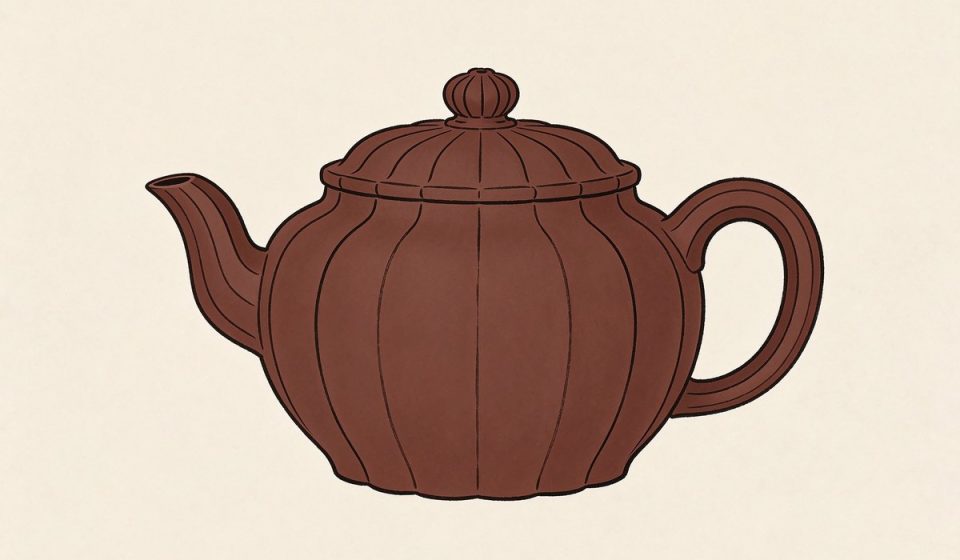
Ribbed pots — jinwen — divide the body into repeated flutes or petals: chrysanthemum, lotus, melon, and the many segmented variants. Ribbed and floral forms (huahuo) are often discussed together because both depart from plain geometry, but they are different disciplines. Floral work imitates an object; ribbed work repeats a proportion. The difficulty of ribbed pots is that repetition has no tolerance.
The measurements that decide quality
- Even spacing: from directly above, the ribs should divide the circle evenly. Uneven spacing jumps out immediately, especially at the shoulder where the curvature changes.
- Equal depth: each flute should be pressed to the same depth. Shallow-standing ribs look like scratches.
- Continuity through the lid: the ribs on the lid should line up with the body ribs when the lid is seated. This alignment is the single most reliable quality signal.
- Continuity to the base: the ribs should run from the rim down to the foot without fading out, and the foot should follow the same divisions.
How it is made
A ribbed body is formed in a mould or pressed onto a ribbed former, with each division worked individually by hand afterwards. The wall thickness varies across the section — thin at the crest of a flute, thicker in the valley — so the pot dries and fires unevenly. Potters accept a high scrap rate; potters who do not accept it produce ribs that are shallow and safe.
This is why genuinely good ribbed work is expensive. Look for crisp crests, no slumping at the shoulder, and no firing cracks running along the valleys, where the wall is thickest and shrinks last.
Floral forms: the other discipline
Floral pots are modelled as pumpkins, gourds, bamboo sections, lotus pods, or animals. The test is whether the pot still works: the lid must seal, the spout must pour, the handle must take a grip, and the body must hold heat. Many floral pots fail on exactly these points, because the modelling took all the attention.
When evaluating a floral pot, ignore the decoration for a moment and treat it as a brewing vessel. Fill it, pour it, open and close the lid ten times. If it passes, the modelling is a bonus; if it fails, the modelling is irrelevant.
Cleaning and maintenance
Ribs create valleys that collect tea. That is not a defect, but it changes the routine: ribbed pots want a soft brush along the flutes and more frequent rinsing. Never scrub with an abrasive, which will round the crests and destroy the crispness that defines the form.
On floral pots, cleaning is harder still: carved stems, leaves and hollows hold tea and are difficult to reach. If hygiene matters to you, a floral pot is a display object more than a daily brewer.
Buying advice
For a first ribbed pot, choose a simple segmented form — a melon or a lotus with a modest number of divisions — in zijin or duan, and check the lid alignment above all. For a floral pot, buy from a workshop that will show you the pour and the lid in video, because photographs flatter these forms and hide exactly the failures that matter.
Ribbed and floral work is where the craft is most visible and most often faked. Both cases reward the same method: count the divisions, check the alignment, and then use the pot as a pot.