Family Workshops and the Second Generation
The workshop as a family business
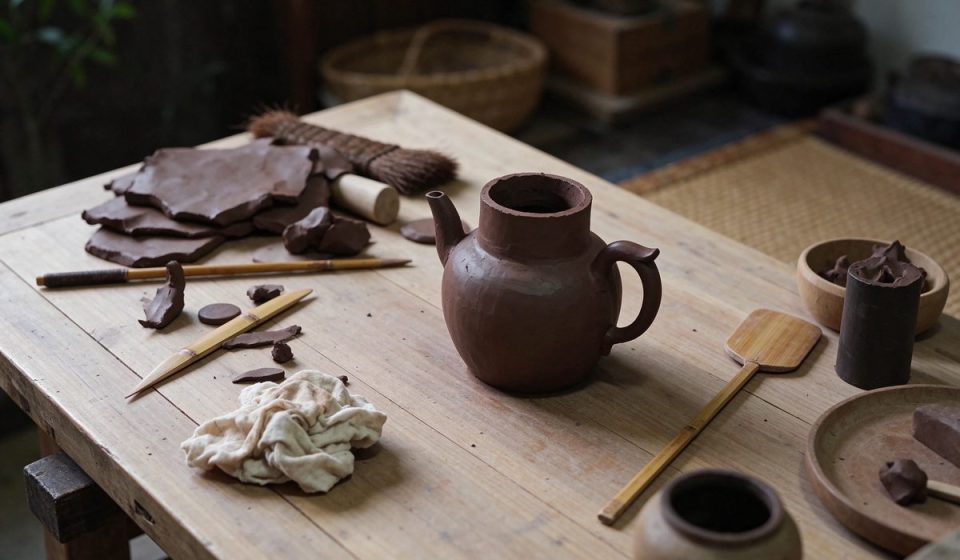
Most Yixing pots are not made by solitary artists. They are made in family workshops that have operated for two or three generations: a father who runs the kiln schedule and the sales, a mother or aunt who does the finishing, sons and daughters who form bodies, and apprentices who do the preparation. Understanding this structure explains a great deal about pricing, consistency and the meaning of a seal.
How a family workshop is organised
- The head. Usually the person whose name and seal the workshop trades on. Takes design decisions, handles difficult shapes, receives commissions.
- Senior family members. Long practice, high skill, often responsible for the parts of the work that determine quality: lid fitting, spout setting, finishing.
- The second generation. Trained from childhood, often technically excellent, sometimes with a different aesthetic from the parent; increasingly likely to have formal art-school training.
- Apprentices and hired hands. Do preparation, standard forms and repetition work. Their output may carry the workshop seal.
Why this produces consistency — and confusion
A family workshop is a quality system: skills are transmitted directly, standards are enforced by the head, and everyone works to the same proportions. That is why pots from a good family workshop look like siblings and hold a consistent level of fit and finish.
The confusion is about authorship. The seal represents the workshop, not necessarily the individual whose name appears in it. A pot may be formed by a daughter, finished by an uncle, and stamped with the grandfather’s mark — all legitimate, all part of the same craft tradition, and all priced differently depending on what the seller claims.
The second generation problem
Succession is the trade’s real risk. A famous name passes to children who may be superb potters, competent managers, or neither. Markets often assume continuity that does not exist, and prices for “the family’s work” can rest more on a grandfather’s reputation than on the current output.
For a buyer, this means the name of a workshop should be evaluated as a brand with a recent history, not as a guarantee inherited from the past. Ask what the workshop has produced in the last five years and who is making it now.
What family workshop structure means for price
Three consequences worth knowing:
- Overhead is low. Family workshops have less structure than companies, so a good pot can be cheaper than an equivalent from a large studio.
- Output is limited. A handful of people cannot produce at scale, so popular shapes go on waiting lists or get copied.
- Quality varies by hand, not by brand. The same seal can appear on a superb pot and a hurried one, because different family members made them.
How to deal with a workshop name
Visit if you can: a family workshop is a small place, and you will meet the people who actually make the pots. Ask who made the specific pot, and whether it was a family member or an employee. Ask how many pots the workshop produces a year, and whether the named head still works at the bench.
If you cannot visit, ask for a video of the workshop and the specific pot, and for the name of the person who formed it. Sellers who deal regularly with family workshops answer these questions easily; those who are reselling from a catalogue usually cannot.
The honest summary
The family workshop is the craft’s backbone and the source of most genuinely good pots at reasonable prices. It is also the place where authorship claims blur most easily. Buy the pot’s physical qualities, ask who made it, and treat the family name as context — valuable, but not a substitute for inspection.