Zisha vs Porcelain vs Stoneware: A Material Comparison
Three materials, three jobs
Most confusion about Yixing pots disappears once you stop asking “which is better” and ask “what is each one for”. Porcelain, zisha and ordinary glazed stoneware are not graded versions of the same thing; they sit at different points on two axes — how hot the body was fired, and whether the surface is sealed.
Porcelain: sealed, bright, neutral
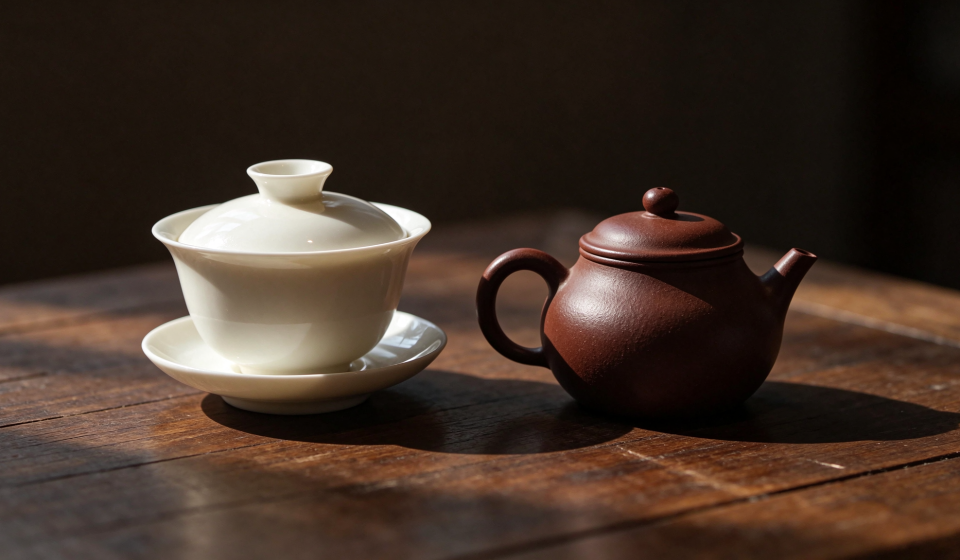
Porcelain is fired high, usually 1,200–1,400 °C, until the body itself becomes glassy, and then glazed. The result is a sealed surface: no absorption, no retention of flavour, no memory of the last tea. For tasting, this is a virtue. A thin-walled porcelain gaiwan shows you exactly what the leaf does — colour, aroma, bitterness, the way a tea opens across infusions — with nothing added and nothing held back.
It is also the most practical vessel in a tasting room: it costs little, survives repeated washing, never needs to be dedicated to one tea, and lets you see the leaf. Most professional tea evaluation in China is still done in porcelain or in glazed ceramic, not in zisha.
Zisha: unglazed stoneware, slightly open
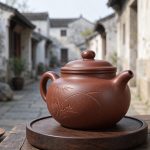
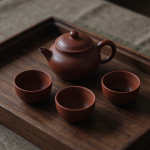
Zisha is fired lower, roughly 1,100–1,200 °C, without glaze. The body is dense but not sealed, with a fine open structure usually described as a “double pore” arrangement — large pores between the grains and smaller ones inside them. In daily use the effect is small but real: heat is held longer, aromatics are slightly rounded, and the wall gradually takes on tea.
The trade-off is commitment. A zisha pot wants one tea family, wants to be rinsed rather than scrubbed, and rewards months of the same routine. It cannot be reset the way porcelain can, and it does not show a tea’s faults as clearly.
Ordinary glazed stoneware: the middle case
Most ceramic teapots sold in the West are glazed stoneware or earthenware: fired somewhere between the two, sealed on the surface, thicker-walled than porcelain. They hold heat better than a thin gaiwan and are far more forgiving than zisha — but they give you neither the neutrality of porcelain nor the slow accumulation of a zisha pot. For many drinkers this is the correct everyday choice; it is simply a different tool.
Where they differ, practically
- Heat retention: zisha and thick stoneware hold temperature through a short steep; thin porcelain loses it fast. This is why a 100 ml zisha pot brews oolong comfortably where a small gaiwan needs preheating.
- Aroma: porcelain transmits high notes; zisha rounds them and slightly mutes the sharpest edges. Neither is “more accurate” — one is more analytical, the other more forgiving.
- Cleaning: porcelain tolerates detergent and hot water. Zisha does not; it should be rinsed, air-dried, and left alone.
- Cross-use: porcelain switches teas freely. Zisha does not, because it remembers.
- Durability: both are durable, but zisha is more sensitive to thermal shock. Never pour boiling water into a cold, dry zisha pot; warm it first.
- Cost: a usable porcelain gaiwan costs the price of a meal; a usable handmade zisha pot starts at many times that.
How to choose
If you are still learning what your tea tastes like, buy porcelain first. It will teach you more per dollar than any pot. Add a zisha pot when you have settled on one or two teas you drink weekly and you want a vessel that holds heat and improves with use. If you drink a wide range casually, a glazed stoneware pot is the sane middle path.
What you should not do is buy an expensive zisha pot as a first vessel and then brew six different teas in it. That is the single most common way people spend a lot of money and get a confused pot and confused tea in return.