Literati Taste: Plainness, Inscription and the Scholar’s Pot
Why scholars wrote about teapots
In the late imperial period, tea was part of a literate culture of connoisseurship: poetry, painting, letter writing, and an aesthetic of restraint. Zisha fitted this world precisely — unglazed, quiet in colour, small enough to hold in one hand, and capable of carrying an inscription. A pot could be an object of use and an object of meaning at once.
The aesthetic they argued for
- Plainness. A body with no decoration, valued for proportion and material.
- Restraint. Small, quiet, and shaped close to the geometry of a circle or a square.
- Material honesty. A surface that showed clay rather than glaze or ornament.
- Usefulness. A pot that poured well and sat comfortably in the hand.
This is essentially the standard modern potters still invoke when they praise “simple” work, though the vocabulary has changed.
Inscription and the pot as a surface
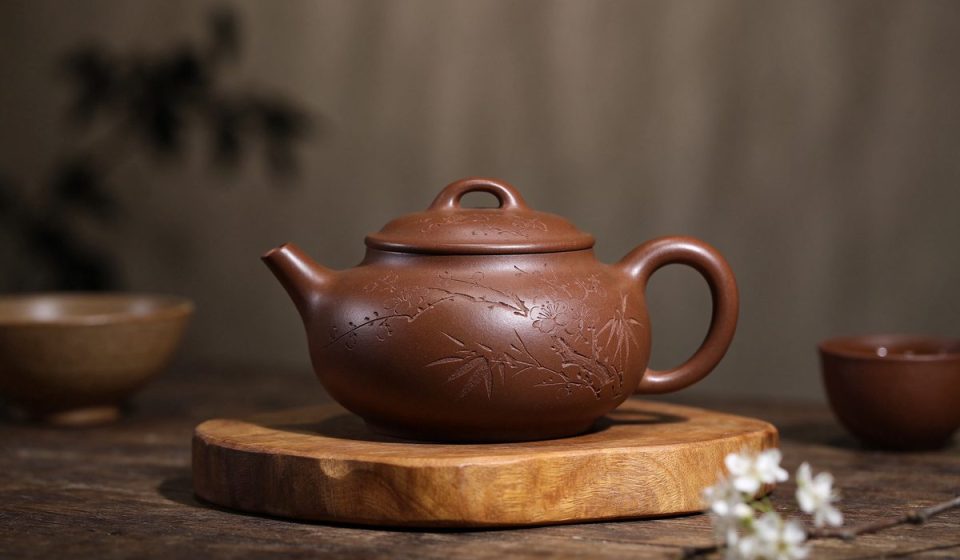
Once a pot carried incised or painted text, it became a medium. Calligraphy, short poems, dedications and dates appear on bodies and lids. This is where the literati influence is most visible: the pot as a place to put words, and the words as a way to bind the object to a person and an occasion.
For a buyer, inscriptions are a useful signal and a risk. Genuine period inscriptions are a record; added ones are decoration. Compare the carving style with the clay’s age and finish.
The collaboration model
Literati often did not make pots. They designed, inscribed, and commissioned them from potters, and the resulting objects sometimes carry a maker’s seal and a scholar’s text. This division of labour is the ancestor of the modern pattern where a designer and a maker are different people, and it complicates attribution in the same way.
Why this matters now
Three practical reasons.
- It explains the taste you will encounter. The preference for plain, thin, quiet pots is not arbitrary; it has a documented lineage.
- It explains the premium on inscriptions. Objects with text carry an aesthetic and historical charge that objects without text do not.
- It cautions against ornament. Much of what is sold as luxurious today — heavy appliqué, enamel, metallic trim — is precisely what this tradition argued against.
The tension worth knowing
Court taste and scholarly taste diverged: the palace wanted ornament and enamel; scholars wanted plainness. Both produced excellent objects, and both are collected today. Knowing which tradition a pot belongs to tells you what to look for and what a fair price is.
A short way to use this
When a pot is presented as “traditional”, ask which tradition. Plain unglazed work, or decorated court production? The two have different standards, different markets, and different failure modes, and a price justified by “tradition” without a specific tradition is a price without a basis.