Firing: Wood Kilns, Electric Kilns and What Heat Decides
Fire is half the craft
A pot is not finished when the maker finishes it. Between forming and the shelf sits the kiln, and the kiln decides colour, density, and whether the pot survives at all. Understanding firing explains a great deal that otherwise looks like inconsistency: why two pots from the same clay differ in tone, why some sound different, why thick and thin walls behave differently.
Wood kilns
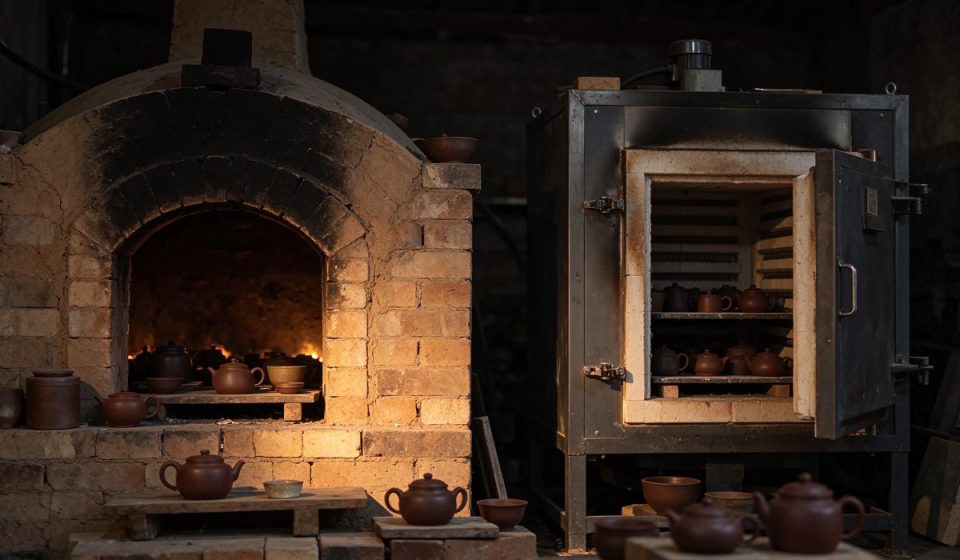
In the historical period, pots were fired in wood-burning kilns, often dragon kilns built into a hillside. Conditions varied enormously with position in the kiln: temperature gradients, ash, draught and reduction all differed. The result was uneven colour, fire marks, and a high loss rate — and also a depth of surface that controlled kilns rarely achieve.
Electric and gas kilns
Modern kilns give controllable temperature and atmosphere. Colour becomes repeatable, losses fall, and the potter can fire to a specific target. The price is uniformity: the subtle variation of a wood firing is replaced by a consistent result. Both are legitimate; they produce different objects.
Oxidation and reduction
The atmosphere in the kiln changes the fired colour. An oxidising atmosphere (plenty of oxygen) tends toward warmer, lighter tones; a reducing atmosphere (oxygen starved) pushes iron-rich clays toward deeper, cooler colours. Potters use this deliberately, and a pot’s colour is partly a record of how the kiln was run.
Temperature and its consequences
- Under-fired. Dull sound, soft surface, high absorption, earthy smell when wet. A genuine defect: the pot will stain, absorb odours and brew poorly.
- Well fired. Clear short ring, dense surface, grain visible, correct colour for the clay.
- Over-fired. Denser, glassier, sometimes slightly deformed; can approach porcelain behaviour and lose the porosity that makes zisha useful.
Why thin walls are expensive to fire
Thin sections distort, warp and crack. A maker building 2 mm walls knows that a proportion of the batch will fail in the kiln, and prices accordingly. This is the real reason handmade thin pots cost what they do — not the forming hours alone, but the losses that follow them.
What you can read from a fired pot
- Colour variation across the body: wood kiln or a deliberately varied firing.
- Fire marks or ash effects: wood kiln, usually a sign of an older or artisanal firing.
- Sound: a proxy for density and firing.
- Surface: glassy suggests high firing; chalky suggests low.
- Cracks or warping at the rim or base: firing stress, sometimes visible only when wet.
The practical point
When a pot is described as “high-fired” or “wood-fired”, you are being told something about how it will behave, not just how it looks. Ask what it means for the pot you are holding — density, sound, absorption — rather than accepting the phrase as a compliment.