Trying a Pot: Five Steps Before You Decide
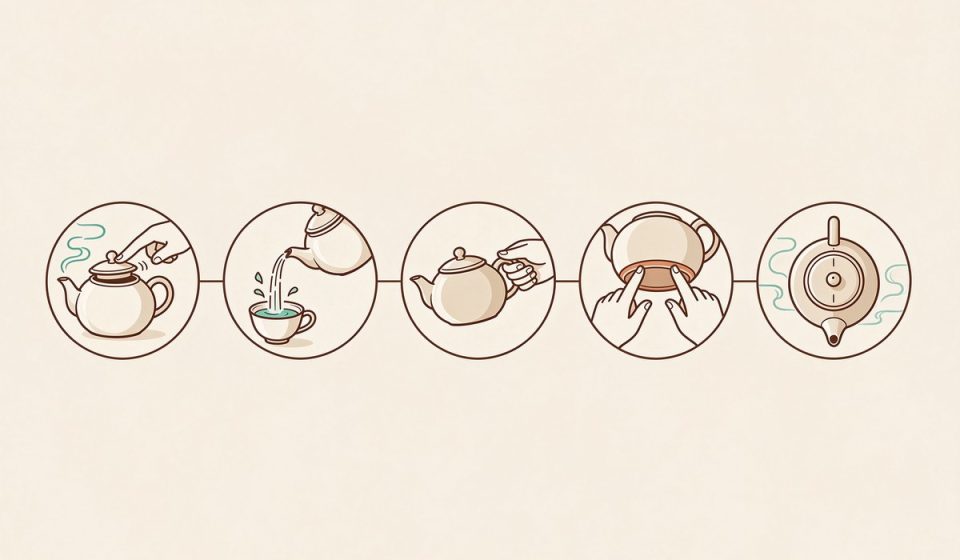
Five steps to decide about a pot
When you are past the impulse stage and seriously considering one pot, a fixed sequence prevents the two common errors: buying something beautiful that does not work, and talking yourself into a flaw because you like the colour.
Step 1: define the job
What tea, how many people, how long an infusion? A 90 ml pot for solo yancha and a 220 ml pot for family oolong are both good pots and not interchangeable. Buying without a job description produces a shelf of pots that all do the same thing.
Step 2: bench the candidates
Put three examples in front of you — in a shop, or as videos on a screen — and compare them against each other rather than against an ideal. Within a tier, differences in pour and lid fit are visible.
Step 3: run the physical checks
- Lid: fingertip lift, no rock, no fall-out when tipped.
- Pour: fill, pour steadily, stop at two-thirds; watch for hesitation and run-back.
- Interior: torch, rotate, look for wheel lines and a spout ridge.
- Wall and rim: thin, consistent.
- Surface: grain, colour shift, no coating at the base ring.
Step 4: brew a real session
If at all possible, brew the tea you intend to use. The pot must hold heat, pour to the last drop and let you control the infusion. A pot that is awkward with your own tea and your own hands is the wrong pot, however good it is objectively.
Step 5: decide against the price, then sleep on it
After the checks, write down the price you think the pot is worth — before seeing the asking price if you can manage it. Then compare. Sleeping on it filters a surprising number of purchases that were driven by the room rather than the pot.
What “walk away” looks like
Poor pour, rocking lid, coated interior, a near-invisible crack, or a price that needs a story to justify it. None of these improve with time, and all of them are visible in ten minutes if you follow the sequence.
A note on trial purchases
If the seller offers a trial period, use it properly: brew daily for the whole window, not once on arrival. Problems with lids, heat retention and pour appear on the third or fourth session, not the first.
The value of the sequence
It converts a taste decision into a series of checkable facts and leaves the taste decision where it belongs — a preference about shape and colour, made after the pot has passed the tests that matter.