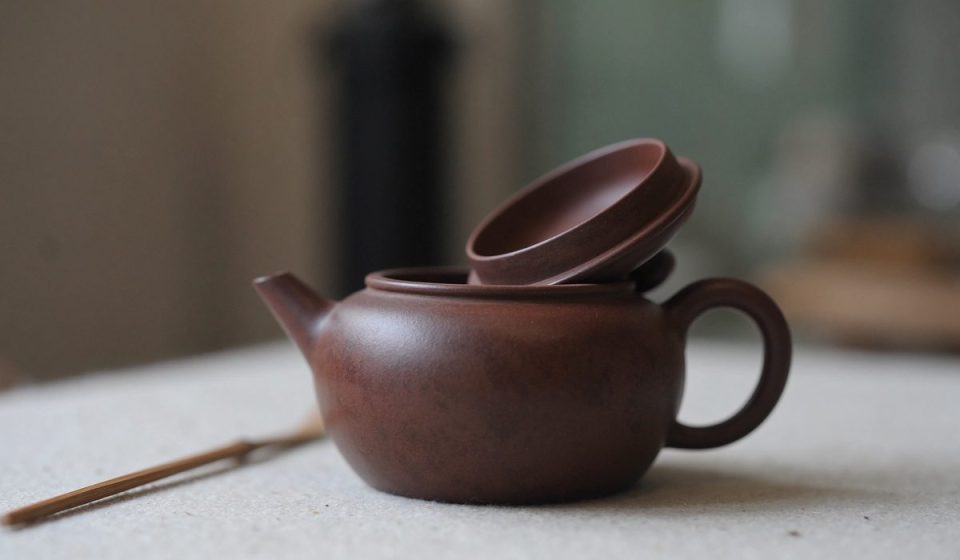
Identify Sound
The last check, for two specific problems
Sound and weight are poor general tests. They will not tell you the clay family, the maker, or the age. They are good at exactly two things: detecting cracks and detecting under-firing. Use them for that and nothing else.
Weight
Zisha is dense. A 150 ml pot of sound, well-fired clay weighs roughly 90–130 g depending on wall thickness; a lighter pot is thin-walled, under-fired, or made from a leaner body with more non-clay mineral content. A noticeably heavy pot for its size usually means thick walls, which brew sluggishly and feel clumsy.
The useful move is comparative: hold three pots of similar volume and compare. A pot that feels hollow or light is telling you something about its body.
Sound, correctly
Tap the lid lightly against the body, or flick the body with a fingernail. What you want is a short, clear, slightly metallic ring that decays quickly. Zisha’s porosity damps resonance, which is why it does not ring like porcelain.
- Clear, short ring: sound body, well fired.
- Dull thud: a crack, a repair, or under-firing.
- Dead, flat note: often a filled fracture or a pot that has been soaked.
- Long ringing: usually denser, higher-fired clay, sometimes porcelain-like bodies sold as zisha.
Do not tap hard, and never tap the spout — it is the thinnest, most fragile part.
Crack detection
Fill with warm water and tap gently again. A crack that is invisible dry often produces a changed note when the pot is wet, because water enters the fracture. Then inspect the rim, the base ring and the spout joint under raking light for a hairline that is darker than its surroundings.
Under-firing
An under-fired pot sounds dull, feels slightly soft at the surface, stains quickly, and often smells earthy when wet. It will also absorb odours and is hard to dedicate to a tea. This is a genuine defect, not a matter of taste.
Why sound is a weak signal in general
Two pots of identical clay, fired at different temperatures, sound different. A pot with thick walls sounds different from one with thin walls. A pot that has been used for years sounds different from a new one. Because the note depends on so many variables, it cannot identify clay or origin — only flag an anomaly.
The combined routine
- Weigh it against a similar pot. Note anything that feels wrong.
- Tap the lid on the body; listen for a clear short ring.
- Fill with warm water, tap again; listen for a change that would indicate a fracture.
- Inspect the rim, base and spout joint under raking light.
- If all three pass, proceed to the decisions that actually matter: pour, lid fit, interior.
Sound and weight are the last two minutes of a ten-minute inspection. They close the case; they do not open it.