Apprentice to Master: How a Yixing Potter Trains
Years at a bench, not years at a desk
Yixing potting is learned by apprenticeship, and the training has barely changed in structure: a young person joins a workshop, is given the simplest tasks, and works up. What has changed is the surrounding economy — a ranked-title system, a global market and a demand for signatures — which puts pressure on a craft that was designed to be slow.
The stages
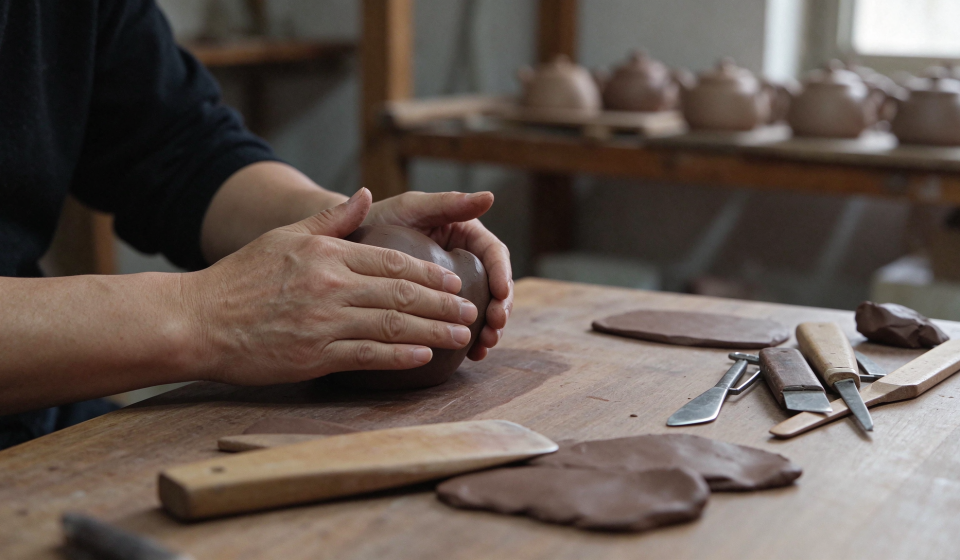
- First year or two: preparation. Wedging clay, rolling slabs, cutting, drying, cleaning the bench. Little potting. The point is to learn how the material behaves before being trusted with a pot.
- Early forms: simple round bodies. A beginner repeats a plain shape — often a Shuiping or a simple drum — dozens or hundreds of times, learning wall thickness, rim level and lid fit as physical habits rather than ideas.
- Fitting and finishing. Setting spouts, handles and lids, and the finishing work that decides whether a pot pours and seals. This is where most of the visible quality of a pot is determined.
- Hard shapes: square, ribbed, naturalistic. Attempted only after the plain forms are reliable, because the failure rate and cost of error rise steeply.
- Individual design. Original forms, inscriptions, personal proportions — usually years after the basics, and often after a period of copying a master’s work closely.
What training produces
Speed is not the goal; consistency is. A trained potter can produce a body with walls even to a fraction of a millimetre, a rim dead level, and a lid that seats without grinding — because they have done it ten thousand times. This is why a competent unknown potter’s plain pot can be genuinely excellent, and why the “unknown” part is irrelevant if you are buying to use.
It also explains a common disappointment: pots from workshops with good reputations but rushed output. Skill is not transferable to a schedule. A trained hand working to a deadline makes a thinner, faster, worse pot, and the failures appear as rocking lids and dribbling spouts rather than as obvious errors.
The title ladder and the training ladder
The official title system rewards years of judged work and a portfolio; it runs roughly parallel to the apprenticeship path but is not identical. A potter may be technically superb and hold no title; another may hold a title mainly through examination performance and administrative career. This is why rank and skill should be judged separately, and why experienced buyers look at the pot rather than the resume.
How to see training in a pot
- Even walls. Thickness consistent around the body and at the rim — a habit, not a decision.
- Clean joints. Spout and handle set without bulges or shadow gaps; the interior smooth where the spout pierces the wall.
- Lid discipline. A seat that is ground or fitted rather than forced, and a lid that lifts without binding.
- Restrained finishing. Tool marks left where they belong and cleaned where they do not; no sanding away of the shape’s crispness.
What this means for buyers
You are, in effect, buying someone’s accumulated hours. The useful question is not “how famous is the maker” but “does this pot show trained hands”. A pot that passes the four checks above was made by someone who spent years at a bench, whatever name is on the base.
And if you are buying for a young potter’s potential, remember that the craft rewards decades. The most reliable appreciation is not in a debut, but in the tenth year of consistent work.