Reading a Maker’s Seal: Four Characters, One Person
A square of clay is the oldest signature in the trade
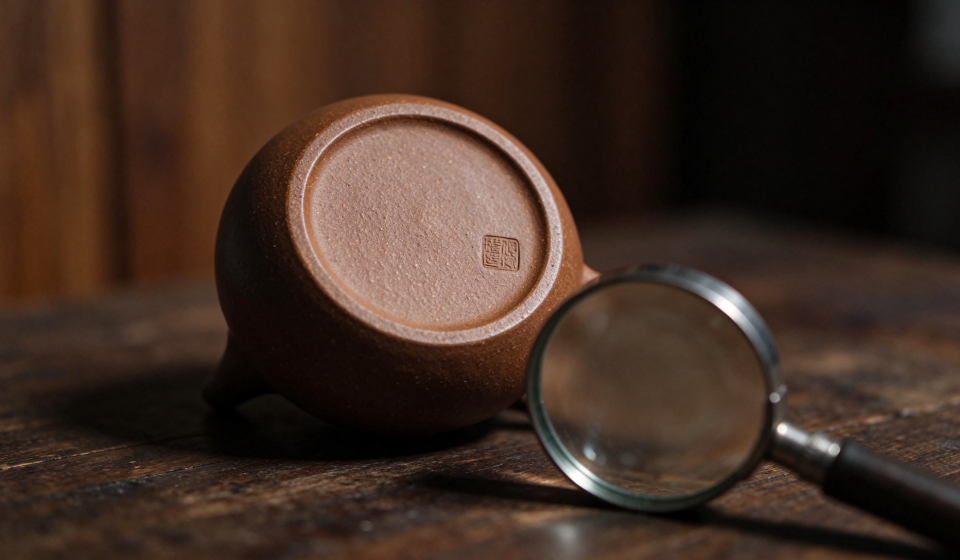
Yixing pots are signed with an impressed seal, usually a small square stamp pressed into the base while the clay is still leather-hard. Many pots carry more than one: a base seal, a seal on the lid, sometimes one under the handle or inside the lid. The seal is, in principle, the maker’s name — four characters in most cases, arranged two by two, read right to left in the traditional manner.
In practice the seal is the weakest piece of evidence on the pot, because a seal is the easiest thing in the workshop to copy, borrow or recycle.
What a seal impression should look like
- Depth and consistency. A hand-pressed seal leaves a slightly uneven impression — one corner deeper than another, the clay pushed up faintly around the edge. A perfectly flat, mechanically even impression suggests a mould or a printed mark.
- Character quality. The strokes should be carved, with visible variation in width and a little roughness at the ends. Printed marks look too clean, too regular, and often have a slightly raised or glossy surface.
- Position. The seal should sit roughly centred in the base, inside the foot ring, in line with the pot’s geometry. Off-centre or awkwardly clipped seals are common on moulded and mass-produced pots.
- Interaction with the surface. The impression should cut into the clay and raise a small lip at the rim. A mark that sits on top of the surface, or that disappears under a coating, is applied.
Why seals are unreliable evidence
Three reasons. First, copying: a seal is a carved stone or metal stamp, and copying it takes far less skill than making a pot. Second, delegation: studios legitimately use the master’s seal on work made by assistants. Third, reuse: old seals from closed workshops circulate, and pots are stamped decades after the fact.
This means a seal can confirm a story only when the pot’s workmanship already supports it. On a pot with smooth cast interior walls, mechanical symmetry and a glassy surface, a “famous” seal is a decoration, not a signature.
The other marks
Beyond the base seal there are three others worth knowing: a lid seal (often the same characters, sometimes a different mark), a handle or body seal, and occasional inscriptions carved into the body — a line of poetry, a date, a dedication. Inscriptions are more informative than seals because carving by hand is slow and leaves a personal signature in the stroke quality.
Some pots also carry a workshop mark, and occasionally a kiln or export mark. A pot with a coherent set of marks — base, lid and an inscription in the same style — is more convincing than one with a single famous seal and nothing else.
Reading a seal without reading Chinese
You do not need to read the characters to judge the impression. Look at the carving quality: are the strokes varied and slightly rough, or uniform and flat? Look at the edges: is the impression a shallow dish with a raised lip, or a flat decal? Look at the surface: does the mark look like pressed clay or like ink?
Then check consistency. If the base seal and the lid seal are identical in every detail including tiny flaws, they were made from the same stamp — which is normal. If they are character-for-character identical but one is 30% larger with the same proportions, one of them is a copy of the other.
The practical rule
Use the seal as a hypothesis, not a conclusion. Ask who made the pot and how the seller knows. If the answer is “the seal says so”, you have learned that the seller has no better evidence — which is itself useful information.