Famous Names of the Ming and Qing
Names that still set the standard
For a buyer, the Ming and Qing names matter less as shopping targets — genuine pieces are museum-grade and almost never on the open market — and more as the source of the shapes and standards still used today. Knowing a handful of them tells you what a modern pot is referring to when it says it follows a classic.
The Ming founders
- Gongchun (供春) — the earliest figure in the trade’s account; credited with the first pots made from the local clay, and with the plain, small form that defines the craft.
- Shi Dabin (时大彬) — late Ming; central to the development of formed, thin-walled bodies, tight lids and the geometric control of the classic shapes. Almost every modern version of a “classic” owes something to his proportions.
- Li Zhongfang (李仲芳) and Xu Youquan (徐友泉) — contemporaries and pupils associated with refinements of shape and with early variations in body colour.
The Qing
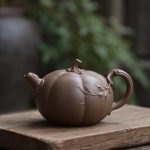
- Chen Mingyuan (陈鸣远) — the great naturalistic maker; pots shaped as nuts, bamboo, lotus and stumps. His work established that a teapot could be a sculpture.
- Chen Mansheng (陈曼生) and Yang Pengnian (杨彭年) — the collaboration that produced the “Mansheng” shapes, where a scholar’s design and a potter’s execution met. This is the origin of the literati pot: simple form, carved inscription, seal.
- Shao Daheng (邵大亨) — known for austere, powerful round and drum forms; his proportions are still the reference for several plain shapes.
- Hui Mengchen (惠孟臣) — associated with small pots and with the export trade; “Mengchen” later became almost a generic label for small red pots.
Why these names still matter
Because the shapes still bear them. A modern “Mansheng” pot refers to a design tradition, not to a person; a “Daheng” drum form refers to proportions, not to a workshop. When a listing invokes one of these names, it is usually claiming a lineage of form rather than a provenance — and that is legitimate, provided the seller does not imply the pot is antique.
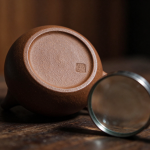
The confusion is easy to exploit, and it is exploited constantly. “Daheng style” on a modern pot is a description; a Ming or Qing date on a modern pot is a lie. The physical evidence — interior tool marks, firing, wear, seal quality — separates them reliably.
What an actual antique would look like
A genuine Ming or Qing pot in private hands would have documented provenance, an auction or collection history, and physical characteristics that modern workshops do not reproduce: uneven firing, hand-worked interiors, wear patterns from centuries of use, and inscriptions carved rather than stamped. It would also be priced in the range of a house, not a holiday.
If a listing offers an antique Yixing pot for a few hundred dollars and the seller is not a recognised dealer with a catalogue, the probability of error is effectively one hundred percent.
How to use these names when shopping
- Treat “Mansheng”, “Daheng” and similar as shape families, and judge them as shapes: proportions, lid, pour.
- Treat any explicit Ming or Qing attribution as unverified unless provenance is documented.
- Learn two or three of these forms well. A buyer who can recognise a good Mansheng-style pot is better equipped than one who can recite a list of names.
The history is worth knowing because it explains the canon — not because it is a shortcut to buying. The canon is the part you can actually use.