Old Clay vs New Clay: Does Age Matter?
Does aged clay make a better pot?
In Yixing, prepared clay is traditionally left to rest — aged, weathered, sometimes for years — before it is used. The claim in the market is that older clay makes better pots, and “old clay” or “aged ore” is routinely used as an excuse for a higher price. The truth is more modest and more interesting.
What ageing actually does
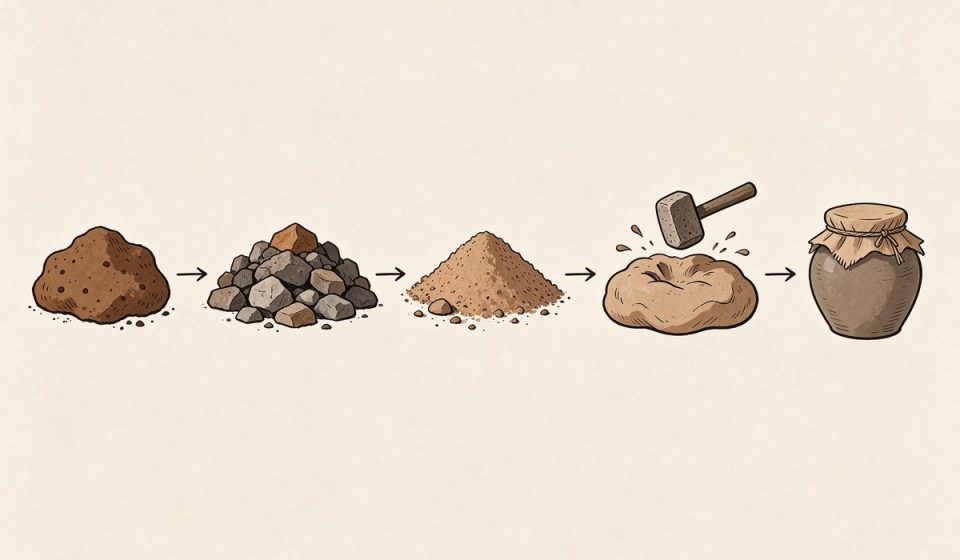
Clay straight from the ground is uneven: moisture is distributed irregularly, organic material is still decaying, and the mineral particles have not settled into a workable relationship. Resting the prepared body in a damp, dark place lets water distribute evenly through the mass, lets bacteria and oxidation break down organic matter, and allows the fine particles to align. The result is a more plastic, more predictable body that forms and dries with less cracking.
That is a manufacturing advantage, and a real one. It shows up as fewer drying losses, better wall consistency, and a body that can be pushed thinner. It does not show up as a different taste in your cup.
Old ore vs aged body
Two different things get conflated:
- Aged body — prepared clay left to rest before use. Common practice, low cost, real benefit to the workshop.
- Old ore — raw rock dug decades ago from a seam that is now closed. Rarity value, unverifiable, and chemically identical to fresh ore from the same seam.
Mining restrictions mean genuinely old ore exists in small quantities, mostly held by long-established workshops and collectors. The phrase “old mine clay”, however, has no standard definition, and most pots sold under it are neither old nor from a named mine.
What ageing cannot fix
Ageing will not turn a lean, over-refined body into good zisha. It will not add iron, and it will not reproduce the grain of a coarser seam. Nor does it change the fired colour much — that is still temperature and atmosphere. A pot praised mainly for “thirty-year-old clay” is usually being sold on a story rather than on the object.
Why the story sells
Rarity is easy to claim and impossible to check. A buyer cannot verify a seam, a date or a stockpile. The seller can, however, charge more, and the pot’s actual qualities — wall consistency, lid fit, pour — are harder to talk about than a legend.
The practical response is to price the pot, not the legend: judge the workmanship, the firing and the material evidence in your hands, then decide whether the pot is worth the money. If the answer is yes only because of a story about age, the answer is no.
Where ageing does matter to you
One place: consistency. A pot made from well-aged body is more likely to have even walls, a flat rim and a lid that seats properly, because the clay behaved predictably for the potter. That is a quality you can see and feel, and it is worth paying for — just not under the heading of “old mine clay”.