Square Pots: Why Four and Six Sides Are Hard
Four sides, six sides, and a different craft
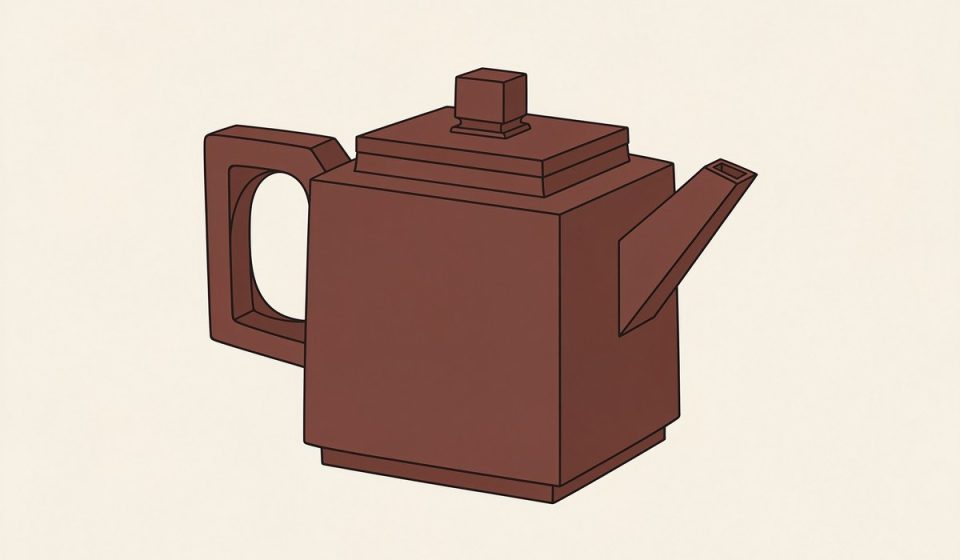
Square pots — sifang, liufang, and the octagonal variants — are the hardest thing in plain zisha. Round forms can be built up on a wheel head and smoothed by rotation; a square body cannot. It is assembled from flat slabs, joined at corners, and every joint is a place where the pot can crack in firing or fail in use.
The shape family includes the true cube with a flat top, the tapered square (wider at the shoulder than at the base), the hexagonal form, and the “four-sided round-cornered” type where the corners are rounded off — the last is easier to make and less prone to chipping, which is why it is common in mid-priced work.
Why it is expensive
- Slab work: each wall is pressed flat, cut to size, and joined; the joints must be scored, slipped and worked so they disappear.
- Drying stress: corners dry faster than faces, so slabs are prone to warping before firing.
- Firing losses: a square pot that survives firing intact has already beaten a significant scrap rate.
- Lid fit: a square lid must seat on four straight edges at once; there is no rotation to hide the error.
What to examine
- Corners: should be crisp and continuous, with no visible seam, no rounded-over slump, and no crack line running from the corner.
- Faces: flat, with no bulge or dish. Hold the pot up to a window and look along each face.
- Lid: drop it in place and try to lift one corner. It should not rock. Then rotate it 90 degrees: on a good pot the fit is unchanged.
- Rim: level on all four sides. Run a fingertip around it — a square pot with a warped rim cannot be fixed.
- Interior: look for V-shaped corner seams. Good work has them smoothed and filled; cheap work leaves ridges or visible gaps.
Pour and handling
Square pots tend to have a narrower interior for their exterior size, and the flat walls leave less room for leaf expansion. The spout is often set on a corner or a face and must be angled carefully so the stream does not hit the far wall. Test with water: a square pot with a poorly angled spout pours crooked, and no amount of tipping fixes it.
They are also heavier than round pots of the same capacity — more clay, thicker walls, and internal corner reinforcement. A 150 ml square pot can feel like 200 ml in the hand.
Clay choices
Square work is usually made in zijin or in a coarse, sand-tempered body because the clay needs to hold shape while the slabs dry. Zhuni is rarely used: its high shrinkage makes flat walls crack at the corners. Where a seller offers a bright red square pot at a modest price, suspect a coloured body or a cast form.
Who it suits
Buy a square pot because you want the discipline of the form, not because you need a better brewer. Round pots pour more easily and suit leaf better. But a well-made sifang is one of the few objects in this craft where the difficulty is visible to anyone — set it beside a cheap version and the difference in the corners is unmistakable.