Shuiping: The Most Practical Shape
The most practical shape
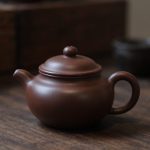
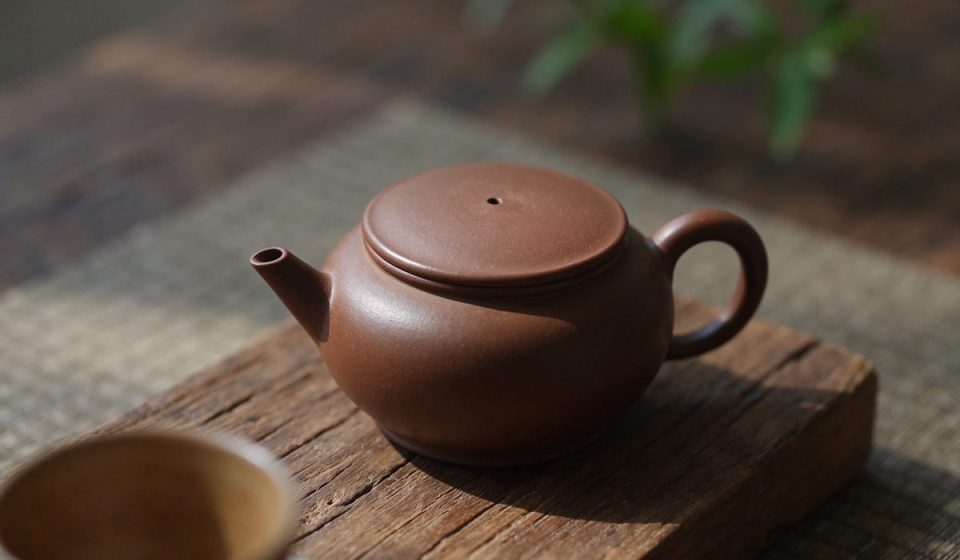
Shuiping (水平, “water level”) is the classic working pot: a low, wide body, a flat top, a short straight spout set almost horizontally, and a handle without ornament. The name comes from the fact that a well-made Shuiping sits level, its rim and lid parallel to the table — the shape is an exercise in horizontality, and it pours better than almost anything else in the canon.
Anatomy
- Body: a low cylinder or a shallow drum, slightly wider at the base than at the rim, so it looks settled rather than tippy.
- Top: flat or with a very shallow dome, with the lid sitting nearly flush.
- Spout: short, straight, and set almost horizontally, emerging from the wall at mid-height. This is the defining feature.
- Handle: a simple round or slightly squared loop, upright, no thumb rest in the strictest versions.
- Base: flat or with a low foot ring; the pot should sit solidly.
Why the horizontal spout matters
A nearly horizontal spout means the pot empties with a minimal tilt. On a 150 ml Shuiping you can pour a full cup without rotating the pot more than about 45 degrees, which keeps the leaf from sliding into the spout and keeps your wrist relaxed during a long session. For anyone brewing six or ten infusions, this is a real advantage over the rounder, taller classics.
It also makes the pour easy to control: the stream starts at a low angle and stops quickly when you right the pot. The usual failure is a spout that is slightly too long and too thin — it looks elegant and dribbles.
Formality and plainness
Shuiping has almost no visual drama. That is the point. The pot is meant to look like a piece of equipment, and its quality shows in execution: the rim must be dead level, the body circular, the spout truly horizontal, the lid flat and perfectly seated.
Check horizontality by setting the pot on a glass table and looking across it: the rim should read as a straight line, parallel to the surface. A tilt of even a degree is visible and, in this shape, unacceptable.
Capacity and use
The usual range is 90–200 ml. The shape works well at the smaller end because the flat body gives the leaf room sideways while the low profile keeps the pour easy. It suits strip oolong, black tea and lighter pu-erh; for tightly rolled ball oolong, the shallow body can crowd the leaf, so choose a slightly taller version.
Heat retention is moderate — the flat top and wide body lose heat faster than a sphere — so this is a shape for teas brewed at 90–100 °C with quick steeps rather than for delicate low-temperature brewing.
Construction clues
The flat top and straight sides expose the wall. Look for even thickness, a rim that is thick enough to hold the lid without chipping, and a clean junction where the spout meets the body. Because this shape is often produced cheaply, it is also where you most often see a cast body with a separately attached spout: the joint shows as a raised ring, and the interior opposite the spout has a visible plug.
Rotate the pot: a handmade body has a slight living wobble in the highlight; a moulded one is mechanically perfect and slightly glassy. Neither is automatically bad, but the price should reflect which one you are buying.