Duoqiu: Stacked Spheres
Spheres stacked into a pot
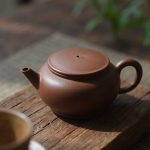
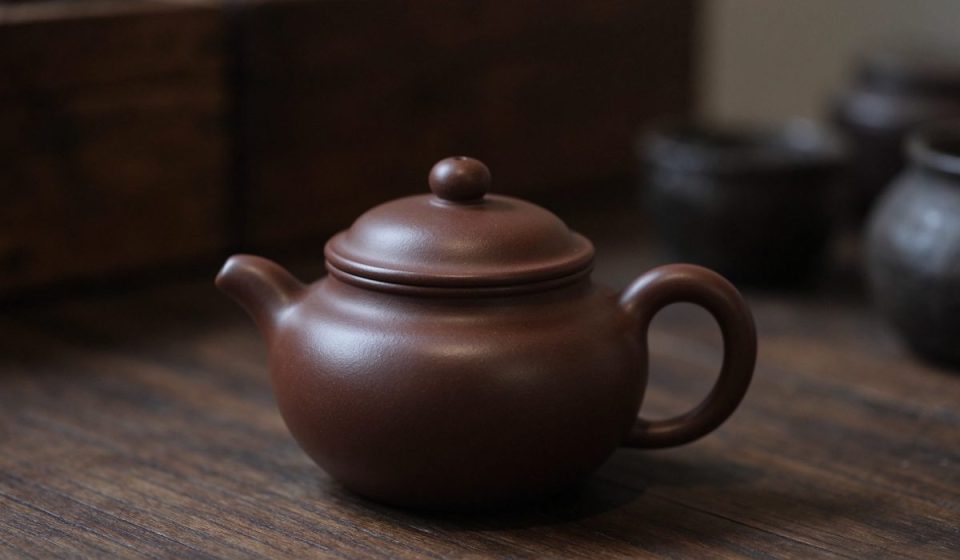
Duoqiu (掇球) literally means “gathering spheres”. The body is a sphere, the lid dome is a smaller sphere sitting on top, and the knob is a third smaller sphere above that — in the strictest versions the three read as a continuous line of decreasing circles. It is the roundest shape in the classical canon, and the one where proportion is most exposed.
Anatomy
- Body: nearly a full sphere, with only a small flat at the base and a small opening at the top. The widest point sits at or just above mid-height.
- Lid: a dome that continues the body’s curvature, not a flat disc placed on top.
- Knob: a small sphere or a flattened ball, centred, sometimes with a tiny collar under it.
- Spout: short and curved, set at or slightly below mid-height, frequently with a subtle S-curve.
- Handle: a rounded loop with a small hook, sized so the negative space between handle and body roughly mirrors the body’s roundness.
Where it goes wrong
The common failures are all about the stacking: a lid dome that is too flat (the pot reads as a ball with a lid), a knob too large (it dominates), a body that is a sphere but with a heavy flattened base (it becomes a ball sitting on a disc), and a shoulder that flares out before the lid, creating a “neck” the form should not have.
Then there is the question of the foot. Duoqiu usually sits on a very small foot ring so the sphere appears to rest almost directly on the table. A wide foot kills the illusion.
Handling and pouring
A spherical body with a short spout is the least convenient classic form to empty: the last of the tea sits below the spout opening, and you have to rotate the pot a long way. Good versions set the spout slightly lower and give the lip a clean cut so the pour remains coherent as the pot tips. Poor versions dribble at the end, and there is nothing to be done about it.
Because the body is thick-walled in most versions, the pot is heavy for its size. A 120 ml Duoqiu can feel like a 200 ml pot on the wrist; check the balance with water in it.
Clay and surface
Duoqiu is usually made in zijin or in a reddish clay; zhuni versions exist but are difficult, because a nearly spherical body in a high-shrinkage clay tends to distort. Where you see a blemish-free zhuni sphere with a truly continuous lid line, the pot is either very good or machine-made — and the interior will tell you which.
Rotate it under a light: on a genuinely handmade sphere, the highlight travels in a slight, organic wobble; on a cast one it moves in a mechanically perfect line and the surface has a faintly glassy sheen.
Who it suits
Duoqiu is a collector’s shape more than a workhorse — beautiful, slightly awkward to pour, and best in smaller sizes. It suits roasted oolong and ripe pu-erh in sessions of two to three people, and it looks particularly good beside a plain tray and small cups. If you want a pot to use absent-mindedly every day, choose Fanggu or Shuiping instead.