Shipiao, the Stone Dipper: Balancing Three Triangles
A pot built from triangles
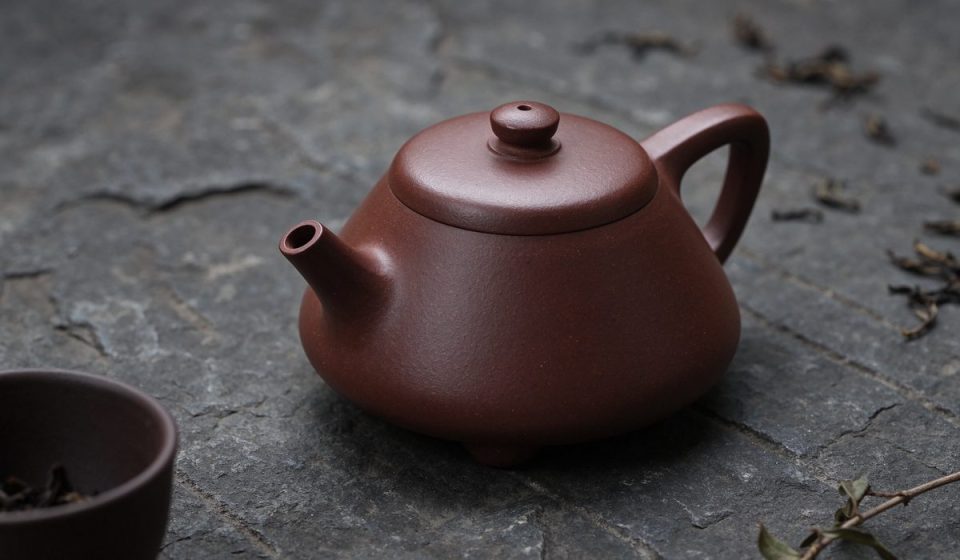
Shipiao (石瓢, “stone dipper”) is the most discussed shape in zisha, and the reason is structural: it is assembled from triangles. Look at a proper Shipiao side-on and you see three tapered forms — the body narrowing from a wide shoulder down to a small foot, the flat or slightly domed lid sitting on a shoulder that slopes inward, and the handle and spout echoing those angles. The pot reads as stable and slightly heavy, like a stone ladle resting on a table.
The proportions that matter
- Body: widest at the shoulder, tapering to a foot that is noticeably narrower than the shoulder — often about two-thirds of the body’s maximum width. A body that goes straight down from the shoulder to a foot of equal width is not a Shipiao, it is a drum.
- Shoulder line: the transition from body to neck should be a clean, slightly concave taper, not a pinch or a bulge.
- Lid: usually flat or very shallow domed, sitting flush with the shoulder, with a simple bridge or button knob. The lid should look as if it belongs to the same geometry, not as if it were added.
- Spout: straight or very slightly curved, set high on the body, angled upward at roughly the same slope as the shoulder.
- Handle: commonly a round or slightly squared loop with a visible thumb rest at the top; the opening should feel balanced against the spout.
Variants you will meet
Workshops produce several Shipiao variants: the taller “high” version with a more upright body, the flatter “dwarf” version where the proportions compress toward the table, and versions with a squared handle and a more angular body. The names shift by region. What stays constant is the triangular relationship between shoulder, foot and spout.
There is also a version built with a slightly concave “waist” — the body pinches inward just above the foot before the base spreads again. In skilled hands this reads as tension; in poor hands it looks like a dent, because the curve is not continuous.
Why it is a good everyday pot
A well-made Shipiao pours cleanly because the spout is set high and straight, and the body’s taper helps the last of the tea release without tipping the pot far. The wide shoulder means a large surface area for heat loss, so it is not the best choice for delicate teas at low temperature — but for oolong, black tea and pu-erh it is excellent.
Capacity typically runs 120–250 ml. Because the shape is wide and relatively shallow, leaf expands sideways rather than upward, which is convenient with ball-rolled oolong that needs room.
What goes wrong in cheap versions
- The shoulder is a straight line: the pot becomes a bucket with a lid.
- The foot is too wide, killing the taper and the visual balance.
- The spout is set low and long, so the pot must be tipped almost horizontal to empty.
- The lid is domed too much, making the pot look top-heavy and hiding an ill-fitting seat.
- The handle opening is too small for adult fingers — a real annoyance in daily use.
How to judge one in your hand
Set it on the table and look from a metre away. A good Shipiao looks slightly low and wide, with the widest point clearly above the middle of the body. Then fill it and pour: the stream should start immediately, run clean, and stop without a drip. Finally, hold it by the handle with a full pot — if your wrist has to work, the handle is placed too far from the body’s centre of mass.