Xishi: Roundness and the Spout
The roundest classic
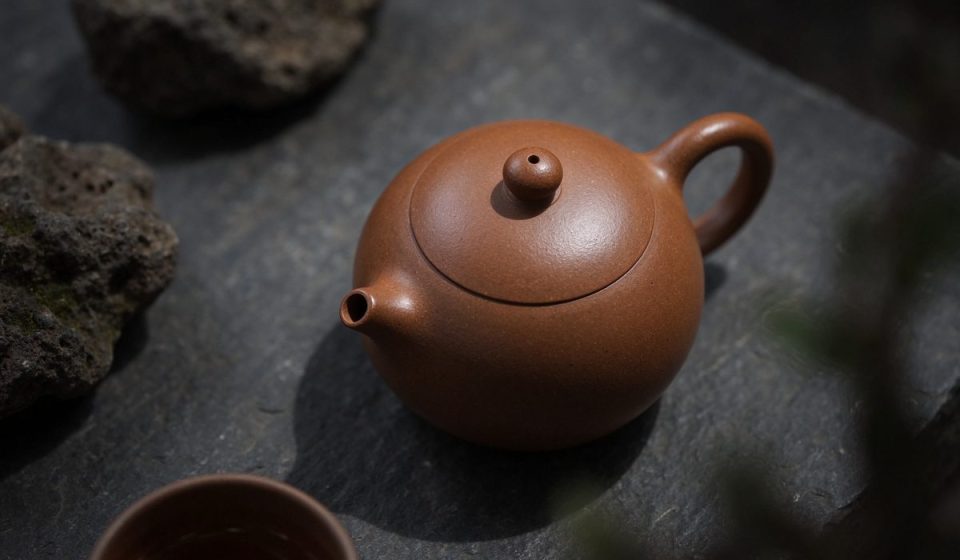
Xishi (西施) is named after the famous beauty of the Warring States period, and the naming tells you what the shape is about: roundness, softness, a body that looks almost plump, with a short spout and a small lid. It is the most recognisable of the “soft” round forms and one of the most common shapes in small pots — especially in zhuni, where the fine red clay and the compact body suit each other.
Form anatomy
- Body: a flattened sphere or egg, widest just below the middle, narrowing smoothly to a small foot. The curve must be continuous — no flat bands, no sudden change of radius.
- Shoulder and neck: very short. The lid sits close to the body, giving a compact silhouette rather than a tall one.
- Lid: domed, with a simple round knob, sitting slightly proud of the rim; the dome should continue the body’s curve rather than interrupt it.
- Spout: short, slightly curved, and set low, close to the body — the classic “one-inch” spout. This is the shape’s defining weakness as well as its charm.
- Handle: a soft loop, often with a small downward hook at the bottom, sitting close to the wall.
The spout problem
Because the spout is short and set low, a Xishi needs careful tipping to empty — the body must rotate a long way before the last tea leaves it. On a poorly made version the spout is both short and thin, and the pour becomes a dribble, or the spout’s lip is not cut cleanly and the tea runs back down the outside.
This is why a Xishi is a shape to buy with your hands rather than from a photograph. Fill it with water and pour slowly: you want a coherent stream and a clean stop. If the seller cannot show a video of the pour, assume the worst.
Typical proportions
The useful rule is that the body’s height should be roughly two-thirds of its diameter. Taller than that and the pot becomes a different shape (closer to a “beauty’s shoulder” or a Wen Dan style); much flatter and it approaches a plate-like form that holds almost nothing.
Capacities are usually small: 80–150 ml is typical. That fits the shape’s history — it was a pot for two or three people drinking a strong tea in many short steeps, not for a large pot of one long infusion.
Clay pairing
Xishi is most often made in zhuni, which shrinks heavily and fires to a dense, bright red body with a fine high ring. The high shrinkage makes thin, round walls difficult, so a zhuni Xishi that is genuinely handmade and evenly round is a real test of skill — and priced accordingly. Zijin versions exist and are more forgiving; duan versions are unusual and can look charming but tend to be thicker-walled.
What to check before buying
- Does the lid dome continue the body’s curve, or sit on top like a cap?
- Is the spout’s lip cleanly cut, and does the stream stop when the pot is righted?
- Is the body’s widest point at or just below the middle, rather than near the shoulder?
- Does the handle leave room for a finger without touching the hot wall?
- Is the interior smooth and free of a visible base plug, which signals cheap construction?
Who it suits
Xishi is excellent for roasted oolong, ripe pu-erh and black tea in small sessions — teas where a compact body, high heat retention and a short pour are assets. It is a poor choice for green tea or for anyone who regularly brews more than three cups at a time. Buy it as a small, personal pot, and accept that the shape asks for careful pouring in exchange for its looks.