The Three Families of Form: Plain, Floral, Ribbed
Three families, one logic
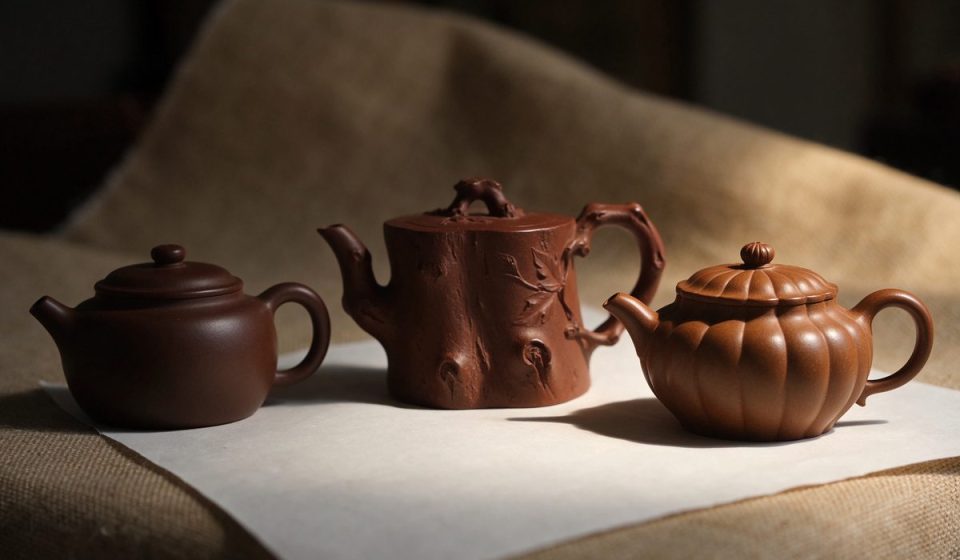
Yixing pots are conventionally sorted into three families: plain (guang huo, also called su mian — “bare surface”), floral or naturalistic (hua huo), and ribbed (jin wen). The classification is not decoration; it describes how the body is built, and therefore how difficult the pot is to make and what it costs.
Plain forms: geometry with no ornament
Plain pots are made from pure geometry — round, square, cylindrical, drum-shaped, or composed of intersecting volumes. Nothing is added to hide a mistake, which is why the plain family is the hardest to fake well and the standard by which potters are judged. Everything is visible: the curve of the body, the transition from shoulder to neck, the line where the foot meets the base.
Within plain forms the shapes are endless but the vocabulary is small: a body (round, square, oval, tapered), a lid (flat, domed, with a knob), a spout (straight, curved, short), a handle (round, square, with a thumb rest), and a foot. Classic shapes such as Shipiao, Xishi, Jinglan, Dezong, Fanggu, Duoqiu and Shuiping are recognisable variants on that vocabulary, each with a fixed set of proportions that potters argue about.
Floral forms: shaped as something
Floral pots are built to resemble a plant, fruit, animal or object: a pumpkin, a lotus pod, a section of bamboo, a gourd, a tree stump. They descend from the Qing-dynasty sculptural tradition, and they are technically a different exercise — the potter is modelling a recognisable object while keeping a lid that seals, a spout that pours, and a body that holds heat.
The failure mode is obvious: floral pots often become ornaments that brew badly. A pumpkin-shaped body can be beautiful and still have a lid that wobbles or a spout set too low. When you evaluate one, judge the brewing first and the resemblance second.
Ribbed forms: regularity as the test
Ribbed pots are divided by regular flutes or petals — chrysanthemum, lotus, melon. The craft here is repetition: every rib must be the same width, meet the lid in the same place, and continue from body to lid to base without drifting. Because the divisions create thin and thick zones in the wall, they also fire unevenly, and a high scrap rate is normal.
Ribbed work is the easiest family to assess from a photograph: count the ribs, check they are evenly spaced, and look at whether the lid’s ribs line up with the body’s. Misalignment of even a few millimetres is visible, and it is the usual shortcut in cheap production.
How the families differ in use
- Plain — the most versatile. Clean interior, straightforward cleaning, reliable pouring; the family most people should buy first.
- Floral — often more decorative than functional; check the pour and lid fit with extra care, and expect more fragile spouts and handles.
- Ribbed — the interior is harder to clean along the flutes; beautiful, but better as a second pot than a daily driver.
Where the classic shapes came from
The names are not consistent across history. Some refer to an object the pot resembles (Jinglan, a well railing), some to a person (Xishi), some to a concept (Dezong, “bell of virtue”), some to a style period (Fanggu, “imitating the antique”). Workshops use the names loosely, and two pots both sold as “Shipiao” can differ substantially in proportion. Learn the family and the proportions, not just the label — the next nine articles in this section take each classic apart.