Glossary: Terms You Will Meet on This Site
The words you will meet, in the order you will meet them
Zisha writing is full of transliterated trade terms. Most of them describe things you can see or touch; a few are marketing. This list covers what actually appears on this site and in shop listings.
Materials
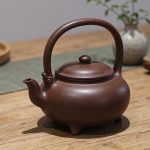
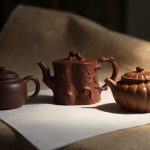
- Zisha (紫砂) — “purple sand”; the unglazed, iron-rich stoneware clay family from the Yixing area, and by extension the pots made from it.
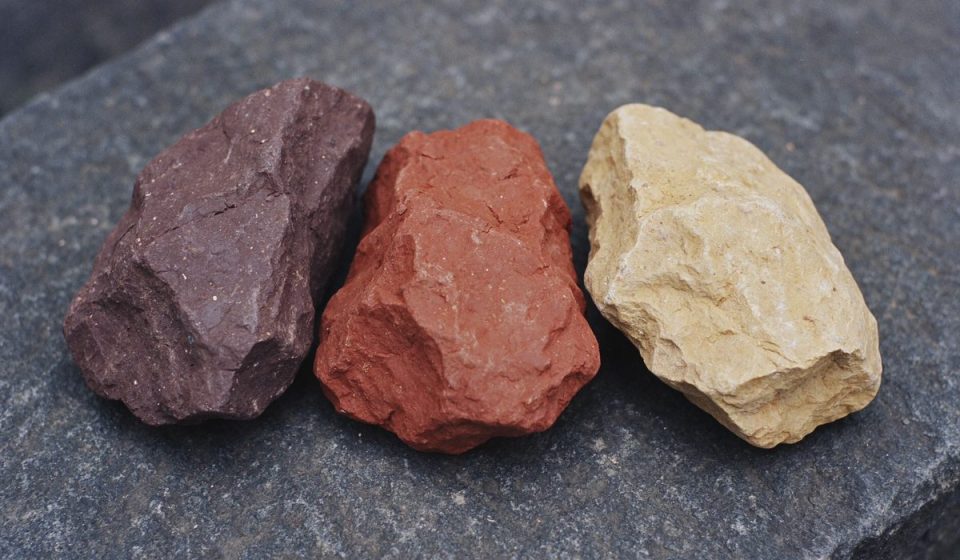
- Zijin (紫金) — the “purple” reference clay family; usually fires to brown-red to deep purple-brown.
- Zhuni (朱泥) — red mud; high shrinkage, fires orange-red to crimson, prone to warping, prized for fine shapes and small pots.
- Duanni (段泥) — pale yellow-tan clay, sometimes with visible specks; good for lighter teas if the pot is thin-walled.
- Qingni (青泥) — greenish-grey clay family, often described as closer to porcelain in temper.
- Huanglongshan (黄龙山) — Yellow Dragon Mountain, the best-known clay source area in Dingshu.
- Lao kuang ni (老矿泥) — “old mine clay”; a marketing term without a standard definition.
Shapes and construction
- Guang huo / su mian (光货/素面) — plain, unornamented forms built from geometry: round, square, cylindrical.
- Hua huo (花货) — “flower goods”; naturalistic forms shaped as plants, animals or objects.
- Jin wen (筋纹) — ribbed forms, with regular fluted or petal-like divisions.
- Quan shou gong (全手工) — fully handmade: body formed by hand and wheel without a mould.
- Ban shou gong (半手工) — half handmade: body formed in a mould, then finished, fitted and detailed by hand.
- Guan zui (灌浆) — slip casting; the cheapest industrial method and the usual source of very uniform, very cheap pots.
Marks and identity
- Yin (印) — the seal impression, usually on the base, the lid and sometimes under the handle.
- Kuan (款) — the maker’s mark or signature as a whole.
- Zhi cheng / title ranks — the official ladder of craft titles awarded to living potters; in practice it also functions as a price tier.
- Ding zhi (定制) — commissioned work, made to a specific brief rather than from a catalogue shape.
Brewing
- Gongfu (功夫) — the high-leaf, short-steep, many-infusion method that zisha pots are designed for.
- Gaiwan (盖碗) — lidded bowl; the neutral comparator used for tasting.
- Cha hai (茶海) — the fairness pitcher the tea is poured into before serving, so every cup gets the same strength.
- Kai hu (开壶) — “opening the pot”; the first preparation of a new pot, in practice a rinse and a few discarded brews.
- Yang hu (养壶) — “raising the pot”; the routine of using and resting a pot so that it develops a patina.
- Baojiāng (包浆) — patina; the soft sheen a pot develops through use.
- Cha shan (茶山) — “tea mountain”; the accumulated tea film inside a long-used pot, treated by some collectors as a sign of age and by others as dirt.
- Yi hu yi cha (一壶一茶) — one pot, one tea; the dedication rule.
Assessment
- Ni xing (泥性) — the working character of a clay: how it behaves when shaped and fired, not a grade.
- Kui lie (亏裂) — firing cracks and losses; a real category in workshop accounting, which is why thin-walled pots cost more.
- Bao jiang du (包浆度) — the degree of patina; used loosely, and often overstated in listings.
A note on translations
Many Chinese terms have no settled English equivalent, and sellers invent their own. When a listing uses a term you cannot verify, treat the description as unverified rather than as evidence. The physical checks in this site’s authenticity section do not depend on vocabulary.