Real or Fake: What to Question First
Start with the price, not the seal
When a pot is offered as “old”, “famous maker” or “old mine clay”, the first thing to interrogate is not the story but the economics. A fully handmade pot of this size takes hours of skilled labour; add drying time, firing losses and a workshop’s overhead, and a floor price exists below which nobody is making that pot. If the asking price is far under that floor, one of the claims is false — usually all of them.
This is the single most reliable test available to a buyer who knows nothing else. Fakes are not made to be sold at genuine prices; they are made to be sold cheap enough that the buyer stops asking questions.
Inside the pot is where evidence lives
Turn the pot over and look at the interior with a torch. On a handmade or half-handmade pot you expect to see: a slightly uneven floor, concentric lines from the wheel head, the faint seam or scar where slabs were joined, a small ridge where the spout was set through the wall, and walls with slightly variable thickness. On a slip-cast or press-moulded pot the interior is smooth, glassy, homogeneous, and suspiciously perfect.
Look for the “two-piece” tell as well: cheap pots are often made as a body plus a separate base disc, with a visible ring where they join. A clean, even ring at the foot is not automatically bad — but a clearly mismatched base colour or a seam that does not correspond to any shaping process is.
Lid, pour, weight, sound
- Lid fit. The lid should sit without rocking, lift with a fingertip, and not fall out when the pot is tipped slowly. A lid that rattles was ground badly; one that binds will seize when hot.
- Pour. Fill with water and pour steadily. You want a coherent stream that stops cleanly. A dribbling spout at the tip means the lip was not finished properly.
- Weight. Zisha is dense. A pot that feels light for its size is either thin-walled (possible, but rare at low prices) or made of a leaner industrial body.
- Sound. Tap the lid lightly against the body. A clear short ring is good; a dull thud suggests a crack, an under-fired body, or a filled repair.
Surface: colour should behave like clay
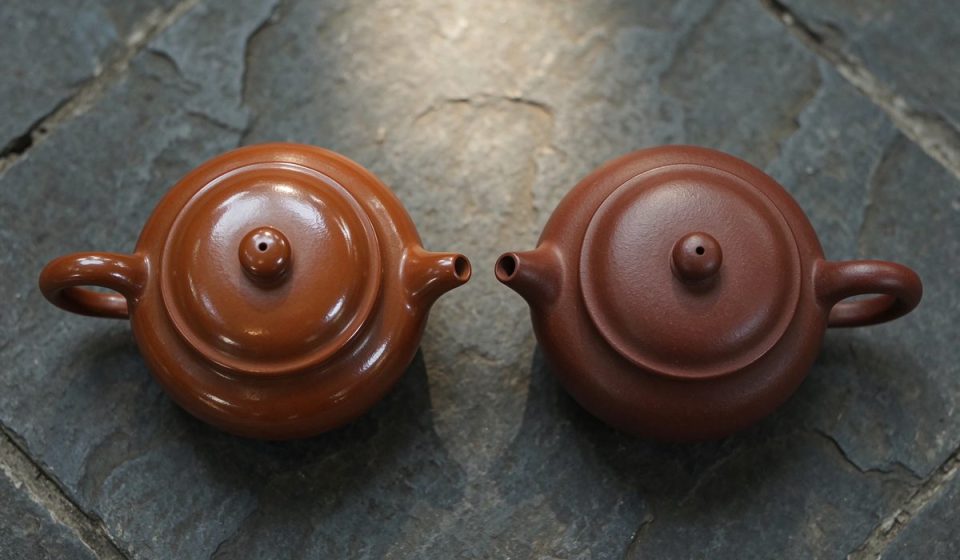
Real zisha shows grain and mineral speckles; it changes slightly with light angle; it does not look like paint. Uniform, saturated, opaque colour with a plastic sheen is the signature of a coloured slip. If the pot is “purple” but the inside is an obviously different colour, the outside was coated.
Patina is another trap. Genuine use leaves an uneven darkening, strongest where fingers and tea touch, with the surface still matte. Artificial patina is even, slightly sticky, and often darker in the recesses of carving than anywhere else. Rub a small area with a damp white cloth: real aged patina yields almost nothing; polish or wax leaves a stain on the cloth.
Claims that should make you slow down
- A named Ming or Qing maker, offered without documented provenance and at a price you can afford.
- “Old mine clay” used as the main selling point rather than the pot’s workmanship.
- Dozens of identical pots presented as fully handmade.
- Photos that never show the base, the inside, or the spout joint.
- A seller who cannot answer “who made this, and how do you know”.
What a good seller looks like
They will shoot a continuous video of the pot — turning it, opening the lid, filling and pouring — rather than a set of flattering stills. They will tell you the clay family, the forming method, the approximate fired temperature, and the workshop, and they will say “I don’t know” when they don’t. They will accept returns. Those four behaviours are worth more than any certificate.
If you are spending significantly, pay for an independent opinion from someone who handles pots professionally and has no relationship with the seller. That fee is cheap next to the cost of learning the lesson with your own money.