Three Basic Forms Worth Starting With
Why three, not ten
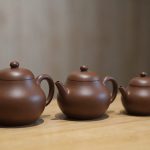
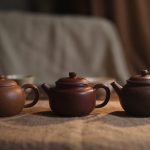
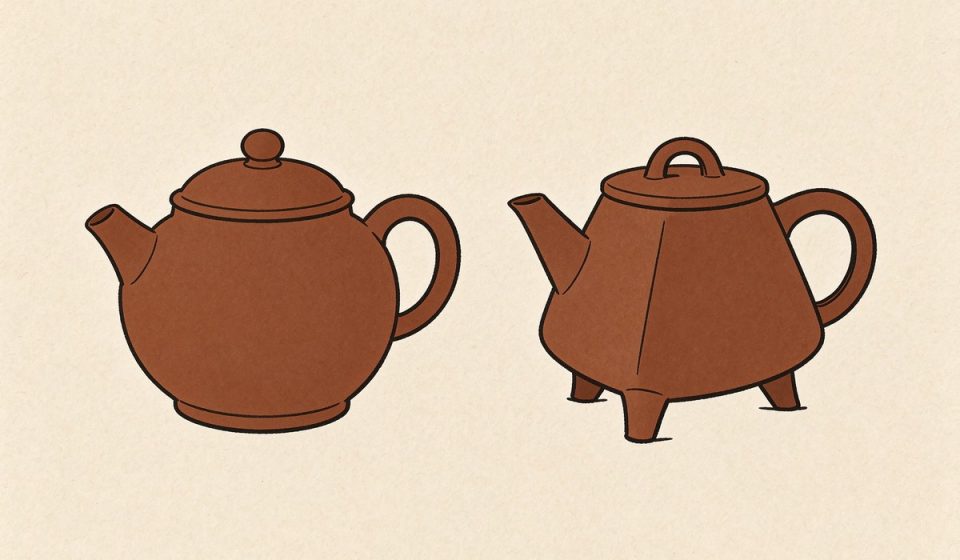
The shape canon has dozens of forms, and a beginner does not need more than three of them. Three plain shapes cover almost every situation, are cheap enough to buy well, and are legible enough that you can tell a good one from a bad one with your hands rather than your vocabulary.
Shuiping — the practical one
A nearly horizontal spout and a flat top make this the easiest shape to pour and to empty. For a first pot, the pour matters more than the silhouette: you will use it every day, and a pot that dribbles is a daily irritation. Shuiping also has a wide, shallow body that suits strip oolong and lighter teas, and its interior is simple, so rinsing is enough.
What to look for: rim dead level (check by eye across the top on a flat surface), spout truly horizontal, and a lid that sits nearly flush.
Fanggu — the all-rounder
A wide, low round body with a generous shoulder. It holds heat well, handles leaf expansion, and looks good on a table without any ornament. If you want one pot that works with oolong, black tea and ripe pu-erh, this shape is the safest choice.
What to look for: circularity from above, lid concentric with the rim, foot trimmed neatly, spout set low and short enough to empty the pot without a long rotation.
Jinglan — the honest one
A straight-walled cylinder. It is harder to make well than the others, and that is its value as a learning shape: with no curve to distract you, every wobble in the wall and every unevenness in the rim is visible. A good Jinglan teaches you what quality looks like, and a bad one teaches you what shortcuts look like.
What to look for: walls plumb, rim level, lid seated inside the rim without rocking, base flat so the pot does not rock on glass.
What to avoid in a starter
- Compact shapes (Xishi, Duoqiu) — charming, but the low short spout makes them awkward to empty; save them for a second or third pot.
- Square and ribbed forms — expensive because they are hard, and the failure modes are subtle enough to miss.
- Floral and novelty shapes — the modelling hides both errors and poor pouring.
How to compare three pots in a shop
Put them side by side and do the same five things to each: set it on the table and press; fill it and pour; open and close the lid ten times; hold it full by the handle; look inside with a light. Then ask the price. Whichever one passed those five without complaint and costs the least is your first pot — and you will have learned more in ten minutes than in ten articles.