Is a Zisha Pot Worth It if You Drink Tea Casually?
Two kinds of drinker
Show me someone who drinks two mugs of supermarket tea a week with milk, and I will show you someone who should not buy a Yixing pot. Show me someone who weighs leaf, has opinions about water temperature and re-steeps the same tea six times, and the pot is the obvious next step. The question is not whether zisha is good; it is whether your brewing is already the shape zisha is designed for.
Where zisha pays off
- You re-steep. Gongfu brewing, or any habit of multiple short infusions, is the pattern zisha is built for.
- You brew near boiling. Oolong, black tea, pu-erh — the heat retention earns its keep.
- You drink one or two teas regularly. A pot dedicated to a tea improves month by month.
- You brew small volumes. Two to four cups, repeatedly, rather than a large pot once.
Where it does not
- One long steep with milk. A 500 ml pot with a five-minute infusion gains nothing from clay; a glazed pot or a mug is cheaper and easier.
- Green tea and Japanese steamed tea. Zisha usually oversteeps them.
- A wide rotation of teas. Without dedication, a zisha pot adds cost and complication rather than quality.
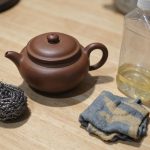
- You want convenience. Zisha asks to be rinsed, dried and rested. A gaiwan is more tolerant.
The honest middle
There is a reasonable middle case: you drink oolong or black tea daily, in a simple two-person quantity, using a strainer in a mug or a small pot, and you are curious about why people make such a fuss. For you, a modest pot in the $80–$200 band is a fair experiment. It will not transform your tea, but it will hold heat, pour better than a mug, and show you what a small dedicated vessel feels like.
A cheaper way to find out
Before spending on zisha, buy a porcelain gaiwan — usually a few dollars — and brew the way the pot would demand: 5 g of leaf per 100 ml, short steeps, repeated. If that method suits you and you enjoy it, a zisha pot will improve the experience. If the method feels like fuss, the pot will not change your mind, because the pot is built around the method.
What you would be buying
A zisha pot is not a better kettle. It is a vessel with specific behaviour: heat retention, slight absorption, and a dedication requirement. If those behaviours match how you drink, the pot is worth its price. If they do not, an expensive pot is a decorative object with a narrow use.
And if you only drink casually but love the object itself — its clay, its shape, the way it ages — that is a legitimate reason too. Just be honest about which reason is yours, because it determines how much you should spend.