Capacity and Price: Why Small Pots Cost More per Millilitre
Price does not scale linearly with volume
Small pots cost more per millilitre than medium ones, and very large pots cost more again. Understanding this curve prevents two common mistakes: overpaying for a large pot because it holds more, and underestimating the premium on a genuinely small, well-made one.
Why small pots cost more per unit volume
Making a 60 ml pot requires the same joints, the same lid, the same spout, the same seal — but with half the material and much less tolerance for error. A thin wall in a tiny body is harder to form and easier to distort. Small pots also have a smaller market, so makers cannot amortise setup across volume.
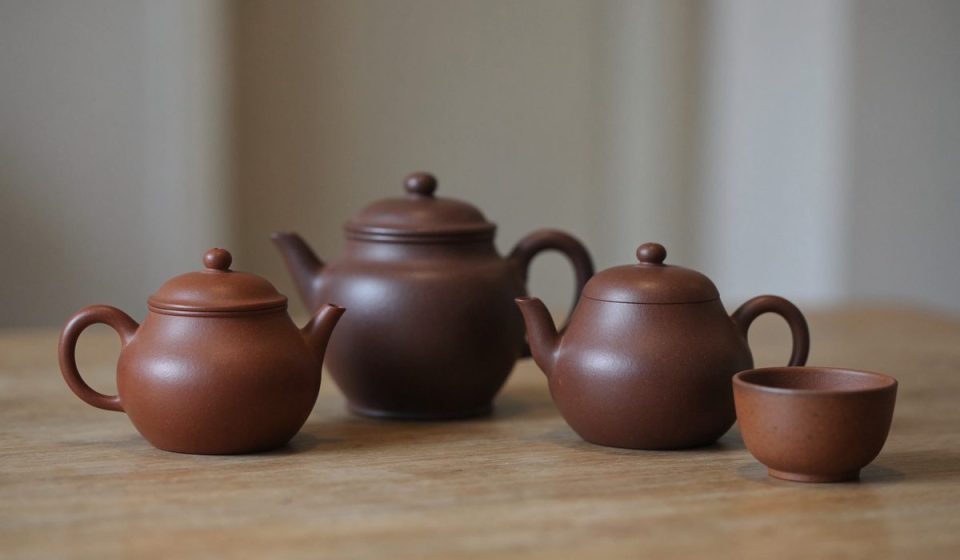
The practical consequence: a well-made 80 ml pot can cost more than a well-made 200 ml pot from the same maker, and that is not a rip-off. It is the cost of difficulty.
The sweet spot
Between roughly 120 and 220 ml, price per millilitre is usually at its best and the pots are the most versatile: enough leaf room for two to four people, small enough to brew short infusions with a high leaf-to-water ratio. For most households, this is the sensible size to buy first.
Large pots
Above 400 ml, price rises with the volume of clay and the difficulty of firing a big body evenly, but the market is thinner and resale slower. A large pot is usually a household or display object, not a brewing instrument, and it should be priced accordingly.
Capacity and the tea you drink
- 60–90 ml: solo, very short infusions, high leaf ratio; expensive per millilitre.
- 100–150 ml: one to two people, the most common gongfu size.
- 150–250 ml: two to four people, good all-round size.
- 250–400 ml: family brewing, longer infusions.
- 400 ml and up: display, or a large household pot; price rises, utility falls.
How capacity is measured
Fill to just below the rim with water and measure it. Do not trust a claimed figure: pots are often described by the volume to the brim, which is 10–20 % more than usable capacity. A “200 ml” pot may hold 170 ml in practice.
Also measure the working volume: with leaf in, you need headroom for expansion, so usable capacity is lower still. For a tightly rolled oolong, allow a fifth of the volume for expansion.
The resale question
Medium sizes resell best because they suit the widest range of buyers. Very small pots resell well among enthusiasts but to a narrower group. Very large pots are slow to sell. If resale matters to you, buy in the middle.
Buying advice in one line
Choose capacity by how many people you brew for and how long your infusions are, then pay the price that size commands — and do not assume a bigger pot is a better pot.