Repairing a Pot: Chips, Cracks, Spouts and What Repair Does to Value
Three kinds of damage, three different answers
Repair decisions depend on where the damage is and whether the pot is still meant to brew. A crack in the body, a chip at the rim, and a broken spout are not the same problem, and a decorative pot can be repaired in ways a brewing pot cannot.
1. A chip at the rim or lid edge
Chips are mechanical and usually localized. If the chip is on the lid’s outer edge or the rim’s outer lip, well away from the seating surface, the pot remains usable: the seat still seals, and hot water does not reach the damaged area. Smooth the sharp edge with fine wet-and-dry paper, working only on the chip, and rinse thoroughly afterwards.
If the chip crosses the lid seat, the lid will leak steam and the pot will lose heat and pressure. That is a functional failure, and only a professional repair or a replacement lid fixes it.
2. A crack in the body
A crack in the wall will not close and cannot be glued safely for brewing: ordinary epoxy is not appropriate where hot liquid sits, and even food-grade adhesives are not designed for repeated boiling. A cracked pot is finished as a brewing vessel.
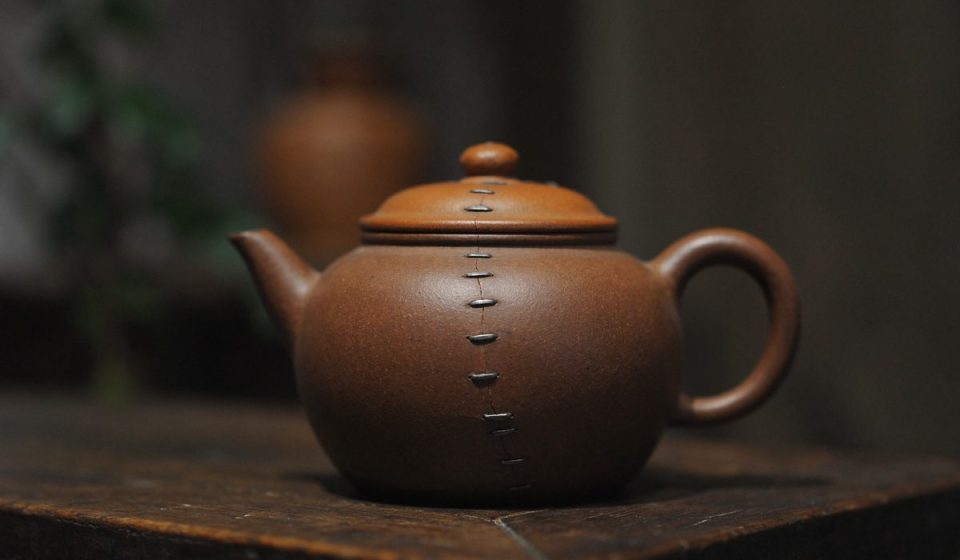
Two options remain. Retire it as decoration, which is honest and costs nothing. Or send it to a restorer who can stabilise the crack — traditionally with a metal staple or a lacquer-and-gold technique — for display or collection value. Ask clearly what the repair is meant to achieve; a stabilised crack is not a watertight pot.
3. A broken spout
A spout broken off at the joint can be reattached by a professional using clay slip and a re-fire, or by a restorer using a reversible adhesive for display. A spout broken mid-length usually cannot be repaired to pour well: the bore geometry is lost. In that case, retirement.
What a repair does to value
In the antique market, a repair reduces value substantially but a documented, skilled repair is far better than an undisclosed one. In the everyday market, a repaired pot is simply a pot with a story, and should be priced as one. The problem is not repair; it is concealment.
How to detect a repair you were not told about
- Colour mismatch along a line, visible under raking light.
- A change in sound when tapped — a repaired section damps the ring.
- Surface texture that is smoother or glossier along one line.
- UV light: many adhesives fluoresce, revealing a filled joint that is invisible in daylight.
- A story that avoids one particular side of the pot.
Prevention, once more
Almost all repairable damage is avoidable: preheat the pot, never tap the spout, hold it with two hands when hot, don’t stack pots in a cupboard, and don’t store lids clamped on. A pot that is handled slowly lasts decades.
The economics
Professional repair of a modest everyday pot usually costs more than the pot is worth. Spend the money only where the object has value beyond function — a family piece, a good maker, a genuine antique. For everything else, the honest move is to retire it and buy a pot with a lid that lifts with a fingertip.