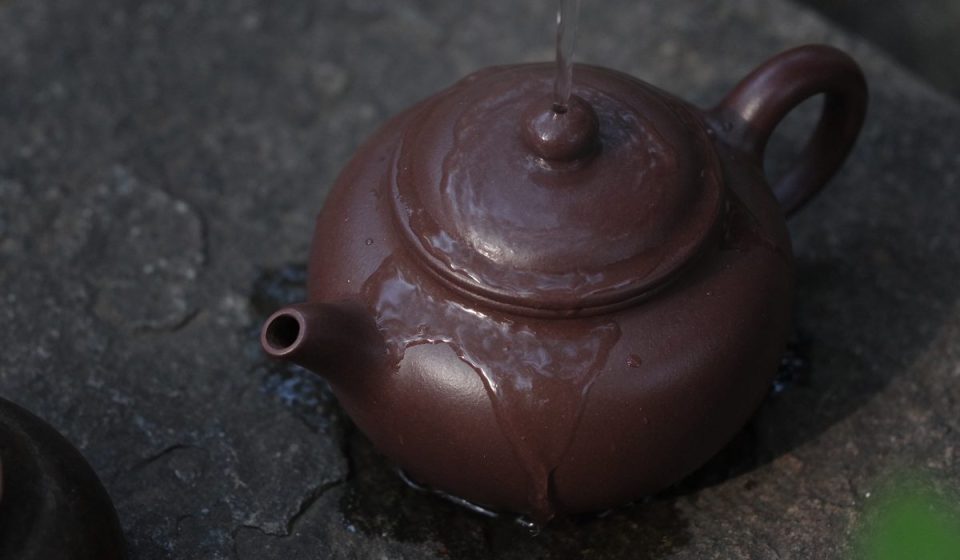
Crack Prevention: Thermal Shock and the Rules That Stop It
Almost every zisha crack is thermal
Zisha is not fragile in the way porcelain is: it survives knocks and drops far better than people expect. What it does not survive is a sudden temperature change across a thin section. Over 90 % of cracked pots broke because hot water met a cold pot, or a cold draught hit a hot one.
The mechanics
When the inside of a wall heats faster than the outside, the inner surface expands more, and the wall goes into tension. Thin sections — the rim, the spout, the lid’s edge, the base ring — cannot absorb that tension. The result is a hairline, usually at the rim or across the base, often appearing minutes after the event rather than at the moment.
The rules that prevent it
- Preheat every pot, every session. A splash of hot water in, swirl, discard, then brew. Ten seconds of work.
- Warm the pot, not just the water. Rinsing the outside with warm water before pouring boiling water in is the safest sequence for a pot that has been sitting in a cold room.
- Never pour boiling water into a pot that has just come in from the cold. In winter, let the pot reach room temperature first.
- Never run a hot pot under cold water. Let it cool on a cloth, not in a sink.
- Do not brew on a cold stone counter in a draught. Put the pot on a mat or a towel, away from an open window.
- Do not pour boiling water into a pot that still holds cold water. Cold and hot together at once is the worst combination.
- Handle with two hands when it is full and hot; a wet hand on a hot handle is how pots get dropped.
- Never tap the spout to clear the last drops. It is the thinnest part of the pot.
Storage risks
Pots stored stacked, lids on, in a cold cupboard, are often the ones that crack at the first brew of the season: the body is cold right through and gets full-boiling water immediately. Warm them gently, or let them stand at room temperature for an hour before use.
Handling a pot that has just cracked
Stop brewing in it. A crack in a brewing vessel will not close, and hot water will open it further. Dry it slowly at room temperature, note where the crack runs, and treat it as a decorative object or send it for repair. Do not put it in the oven, over a flame, or in a microwave to “dry it out”.
What about the chips that are not cracks
A chip at the rim or the lid edge is usually mechanical, not thermal: a knock, a dropped lid, an over-enthusiastic tap. A chip does not necessarily end a pot’s life as a brewer if it is away from the water line and does not affect the lid seat. A crack does.
Buying with this in mind
Inspect the rim and the base ring under raking light, wet the pot and inspect again, and ask how it has been stored. A pot stored cold and dry is fine; a pot that has been through repeated thermal shocks may already have a hairline that only shows when wet.