Identify Pour
The test that needs no expertise
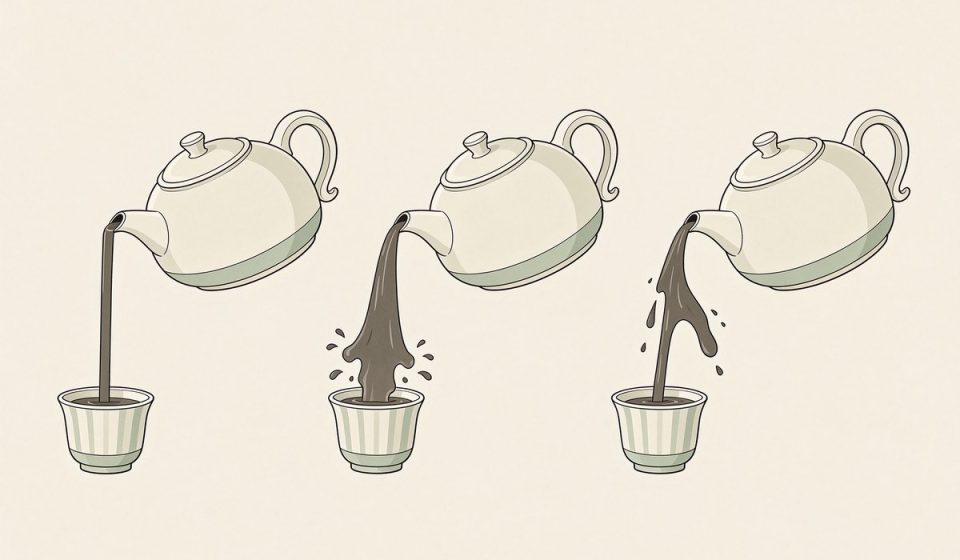
Fill the pot with water, seat the lid, and pour into a cup at a normal brewing angle. Then stop. Three questions, each answerable in seconds:
- Does the stream start immediately when you tip, or does water hesitate and then arrive?
- Is the stream coherent, or does it split, splay or curl?
- When you stop, does water run down the outside of the spout?
These three questions settle more purchases than any seal, certificate or story.
Why the pour reveals construction
Flow depends on the spout’s internal bore, its taper, the smoothness of the inner wall, the position of the outlet relative to the water level, and the fit of the lid. A well-made spout has a bore that narrows gently to the tip and an inner surface finished by hand. A moulded spout usually has a constant bore and a slightly rough interior, which produces turbulence and a broken stream.
A hesitation at the start usually means the bore is too narrow at the base, or the outlet sits too high. A dribble after stopping means the tip is blunt or the cut is angled inward, so a film of water remains and runs back.
The trap: a good pour can be a bad pot
A narrow bore and a high outlet produce an exciting, fast, arcing stream that looks impressive and is actually wrong: the pot empties unevenly, the last of the water pools, and the leaf is left in a puddle. What you want is a steady, unhurried, complete pour — not a jet.
Similarly, a large outlet with a thin body pours beautifully and brews badly in other ways. Judge the pour together with the pot’s volume and wall thickness.
Testing in a shop or at home
- Use plain warm water, no leaf.
- Fill to just below the rim, seat the lid, and hold the pot at a natural angle over a cup.
- Pour slowly and steadily to empty; watch the last third, where problems appear.
- Stop abruptly at two-thirds full; watch for a run-back along the spout.
- Repeat three times; consistency matters more than any single pour.
What can be fixed
A light re-cut of the spout tip can cure a dribble. Enlarging the bore slightly at the base can cure a hesitation, though it risks weakening the spout. Neither is a job for the buyer; both are reasons to negotiate or to walk away.
Remote buying
Ask for a video: fill, pour, stop, in one continuous take, with a cup and a normal angle. A seller who cannot produce this in a minute is either hiding something or has never poured the pot. Either way, the answer is no.