Identify Patina
What patina is
Patina in zisha is not a coating. It is the cumulative effect of hot tea water, steam, oils from the hand, and the slow filling of the clay’s open pores with tea constituents. Over months and years the surface darkens, softens and takes on a deep, slightly translucent sheen.
Because patina forms inside the surface rather than on top of it, it cannot be fully imitated — only approximated.
The four signs of real patina
- Unevenness. It concentrates where hot water and the hand actually reach: the rim, the shoulder, the handle, the spout tip. The base, the lid’s underside and the shaded side stay lighter. A perfectly even darkening is decorative, not accumulated.
- Depth, not gloss. Genuine patina looks wet from below the surface. A waxed pot looks wet from above it, with flat reflections.
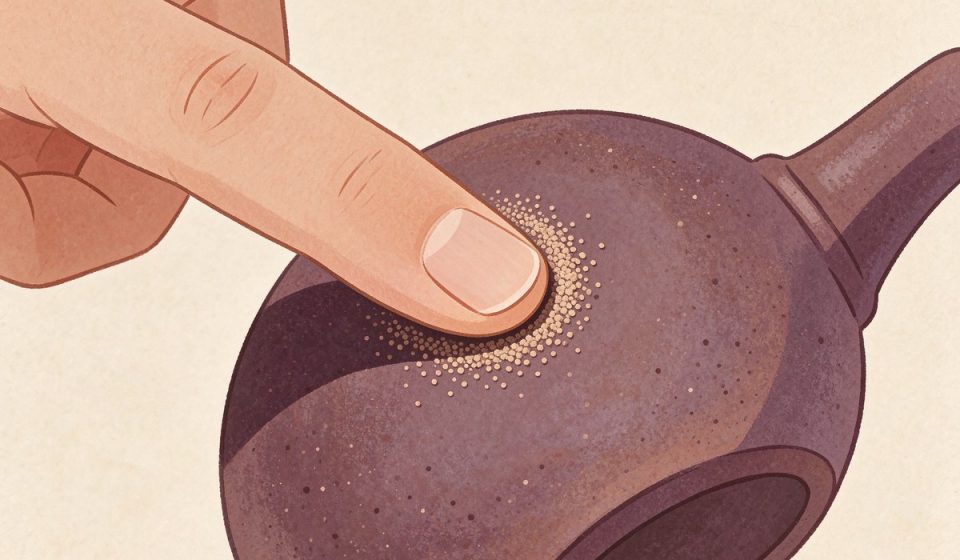
- Grain still visible. Real patina does not smooth the clay; you can still see and feel grain and mineral specks under the sheen. Patina that erases grain means wax, oil or a coating.
- No transfer. A damp white cloth rubbed on a genuinely patinated pot comes away clean or slightly tinted; a stained surface transfers colour.
How artificial patina is made
Three techniques dominate. Repeated tea boiling and drying produces a fast, even darkening. Wax or oil polishing produces a shine without depth. And a modern trick is to brew in the pot intensively for weeks while wiping it constantly, which produces something closer to real patina — but flat, because the pot never had years of intermittent use.
None of these is fraudulent in itself; the problem is the claim attached to them.
The “one tea, one pot” rule and why it matters for judging
A pot used for a single tea family develops patina of a coherent colour. A pot used for everything looks muddled. This is a useful indicator of how a pot has actually been used, and it works against artificial patina, which is usually produced with whatever tea was cheap.
Can patina be cleaned off?
Yes, and that is an important fact. Strong detergent, boiling water with baking soda, or prolonged soaking will strip accumulated patina. This is why patina is a weak authentication signal on its own: it can be manufactured, removed and restarted. What cannot be restarted is the physical evidence of making — interior marks, joints, wall variation.
What to look for when buying a “used” pot
- Ask how long it was used and with which tea. Vague answers plus deep patina is a contradiction.
- Look at the base and the lid’s inside: they should be noticeably lighter.
- Look at the inside floor: patina on the inner floor is thin, because tea sits there only briefly and is poured out.
- Feel the surface with a dry finger: real patina feels slightly tacky and cool, not slick.
- Smell the empty pot. A dedicated pot smells of its tea; a boiled, stained pot smells of nothing or of soap.
Patina as a reason to buy, and not a reason to pay
Patina is the reward for using a pot, and it is one of the genuine pleasures of the hobby. It is a poor reason to pay a premium, because it can be simulated and because it tells you nothing about the clay. Buy the pot for its material, construction and pour; enjoy the patina later, when it is honestly yours.