Brewing Gongfu Tea in a Zisha Pot, Step by Step
From empty pot to first pour
This is the working sequence for one session. It assumes a 100–150 ml zisha pot, a fairness pitcher, small cups, and leaf you have weighed rather than guessed.
1. Heat the water
Bring water to the temperature your tea wants: 100 °C for ripe pu-erh and most black teas; 95–100 °C for roasted oolong; 90–95 °C for lighter oolong; cooler for green tea, which mostly does not belong in a zisha pot anyway. If you have no thermometer, boil and let the kettle sit for a minute or two for the lighter teas.
2. Warm the pot
Pour a little hot water into the pot, swirl, and discard it into the tray. This raises the wall temperature and prevents thermal shock. Do not pour boiling water into a cold, dry pot.
3. Weigh the leaf
Five to eight grams per 100 ml, depending on the tea and how strong you like it. Ripe pu-erh takes the higher end; a light oolong the lower. Put the leaf in and give the pot a gentle shake so it settles rather than stacking against the spout.
4. Rinse (for some teas)
For compressed pu-erh, aged teas and some roasted oolongs, a quick rinse — water in, immediately out — wakes the leaf and removes dust. For fresh strip oolong and most black tea, skip it; the first infusion is worth drinking.
5. The first infusion
Fill the pot to just below the lid seat, put the lid on, and wait. Twenty to thirty seconds is a reasonable start. Then pour all of it — not part — into the pitcher. Leaving tea in the pot keeps the leaf extracting and makes the next infusion bitter.
6. Pour properly
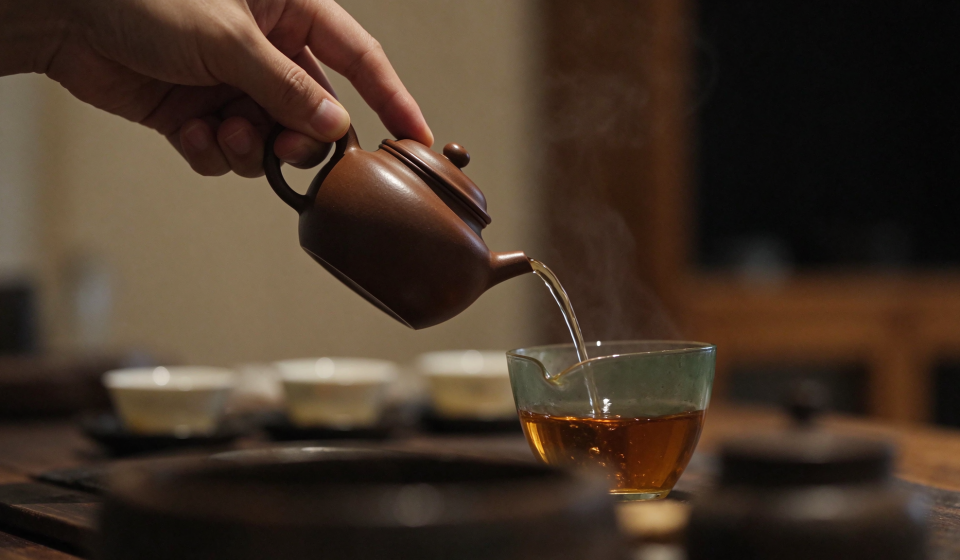
Hold the pot by the handle with the spout over the pitcher, tip steadily, and stop when the flow slows. Do not shake the pot to get the last drops; that brings sediment and blocks the filter.
7. Serve and repeat
Pour from the pitcher into cups, filling them in order and returning to top up the first ones so all cups are equal. Then begin again: each subsequent infusion is usually a few seconds longer than the last. Most teas give five to ten good infusions before they fade.
Common errors at this stage
- Overfilling. Water above the lid seat leaks at the rim and steeps unevenly.
- Part-pouring. Pouring half the pot and leaving the rest to over-extract.
- Not weighing. A “pinch” of ball oolong can be 3 g or 9 g; the difference is the whole session.
- Steeping by clock alone. Taste at each infusion; the leaf, not the timer, decides.
- Forgetting the pot is hot. A full, hot pot is heavy. Hold it with two hands the first few times.
What to notice
Pay attention to the pour itself: does the stream start immediately, stay coherent, and stop cleanly? A pot that needs encouragement is telling you something about its spout. Over a few weeks you will learn your pot’s habits, and that is when the brewing becomes relaxed rather than procedural.