Why Some “Purple” Pots Are Not Purple
The colour name is a category, not a pigment
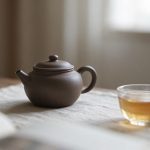
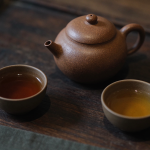
“Purple sand” does not mean the pot will be purple. It is the name of a clay family, and the fired colour of that family ranges from brick red through brown-violet to grey-brown, sometimes with a metallic sheen. The confusion is old and commercially useful: a seller can call almost any dark reddish pot “purple clay” and be technically within the trade’s custom while saying nothing useful.
What actually drives the colour
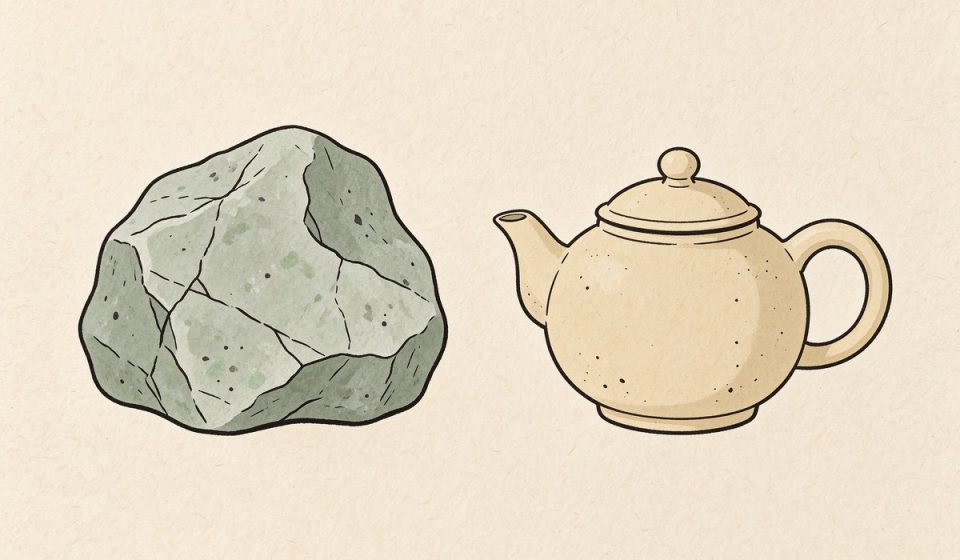
- Iron content. More iron generally means deeper red to purple-brown. Zhuni is high-iron and fires red; duanni is low-iron and fires cream.
- Kiln atmosphere. Reducing conditions push surfaces toward grey, blue-grey and dark olive; oxidising conditions keep them warm red-brown.
- Firing temperature. Under-fired bodies look dull and chalky; well-fired bodies have depth and a slight sheen after use.
- Surface treatment. A slip or pigment can produce a colour the clay itself would never fire to.
Why some “purple” pots are not purple
Because the colour is applied. The most common methods in cheap production are a coloured slip over a coarse body, a pigment wash before firing, and an after-firing polish that darkens and saturates the surface. Each produces something that photographs well and behaves unlike clay.
The tells are consistent: a sharp change of colour between exterior and interior; colour that stops at an edge rather than transitioning; a surface that is glassy or evenly saturated; and colour that continues underneath the foot ring where it should have been masked.
The real purple range
Genuine zijin at good firing temperature usually lands between a warm brown-red and a deep violet-brown, with visible tonal movement across the surface. In strong reduction firing the same body can come out notably grey. Both are “purple clay”. A pot that is uniformly, vividly violet — especially with a sheen — is being described by a colour, not made by one.
Testing colour in your hands
- Base ring interior. Look under the foot. Real pots are fired there too; coated pots often show bare, paler clay or a visible edge.
- Lid seat. The ring where the lid sits is hard to coat evenly. Check whether the colour continues.
- Damp cloth test. Rub an inconspicuous spot with a damp white cloth. Fired colour yields nothing; wax or pigment leaves a mark.
- Light angle. Real fired clay shifts tone as you rotate it under a light, because the grain scatters light unevenly. A painted surface changes much less.
What not to conclude
A brown pot is not inferior to a purple-looking one, and a pot described as “purple” is not automatically better than one described as “red”. The colour is one of the least informative things about a pot: it tells you the family and the firing, and nothing about the wall, the fit, the pour or the workmanship.
Buy the object. If you want a specific look, buy it as a look — but do not let a colour name stand in for quality evidence.