Dezhong, the Bell: A Formal Silhouette
A bell with a formal posture
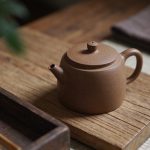
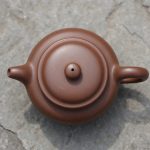
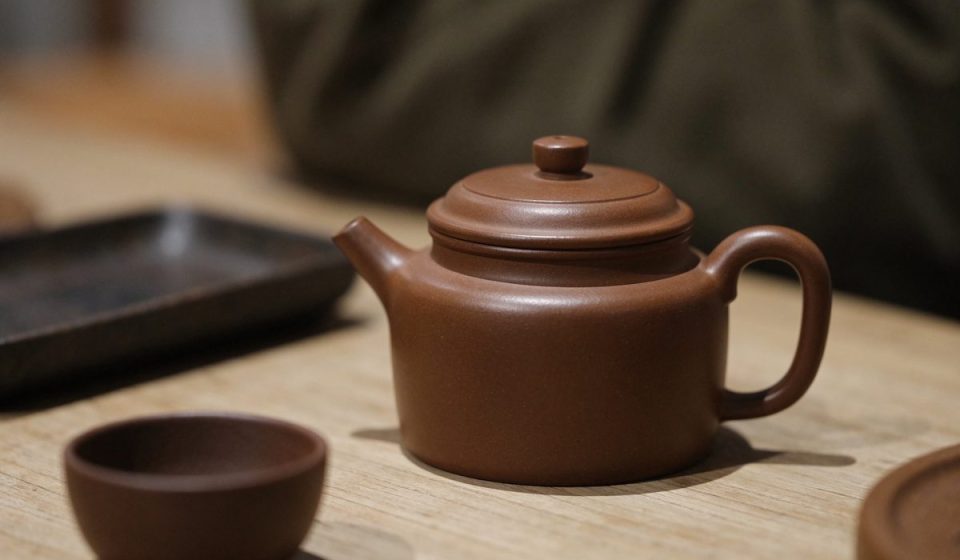
Dezhong (德钟, “bell of virtue”) takes its name from a bell, and the shape does look like one: a body that is slightly wider at the shoulder than at the foot, a short neck, a gently domed lid, an upright posture. It is a restrained, almost formal form — less playful than Xishi, less heavy than Shipiao, and it sits well on a table beside a fairness pitcher and cups.
Form anatomy
- Body: a tall rounded shape, widest at about a third of the way down from the rim, tapering gently to a foot that is only slightly narrower. The curve is convex but shallow — closer to a barrel than to a sphere.
- Neck: short but clearly present, which distinguishes it from the “no-neck” compact forms.
- Lid: domed with a small button knob, sitting inside a distinct collar. The lid dome should look like the continuation of an imaginary line above the neck.
- Spout: short, curved upward, set at mid-height, with a small opening rather than a wide one.
- Handle: an upright loop, often slightly squared, set high, with a small thumb rest.
Proportions and the “tall” trap
Dezhong is usually about as tall as it is wide, or slightly taller. Small variations change the character a lot: push it taller and it becomes top-heavy and tippy; push it wider and it turns into a generic drum. The best examples have a subtle inward taper below the shoulder that gives the pot a waist without looking nipped.
Because the body is tall, the centre of mass is high. Check how it feels when full: a well-proportioned Dezhong should still balance comfortably in one hand, with the handle positioned just above the widest point.
Pour and heat
The spout is usually short and narrow, which gives a slow, controlled pour — good for small cups and for teas where you want to stop the infusion precisely, less good if you are filling four cups quickly. Narrow spouts also clog more readily, so check that the filter holes are clear and evenly drilled.
The closed, upright body holds heat well. Dezhong is a fine pot for roasted oolong, black tea and shou pu-erh at 95–100 °C; it is too enclosed for green tea, where the leaf will sit in hot, still air and go flat.
Firing and surface
The shape’s straight-ish wall and distinct neck create thickness transitions that are hard to fire evenly. On a good pot the colour runs smoothly from body to neck to lid; on a poor one you can see a band of different colour where the neck was joined, or a ring of fine crazing at the shoulder.
Look at the junction between the collar and the body under direct light. A well-made Dezhong shows a continuous surface with no shadow line; a cheap one shows a distinct groove or even a hairline.
Who it suits
Drinkers who want a classic, slightly formal pot that is comfortable in the hand and easy to live with. It is not a showpiece shape — its virtues are proportion and restraint — which makes it a good second or third pot, and a shape that rewards being used daily rather than admired from a shelf.